Strengthening the rights of nature: Environmental education in the tropical Andes
Los Cedros is more than a protected cloud forest in Ecuador – it is a place where biodiversity, legal rights and community action meet. CIPBAT’s program connects school lessons, forest excursions and citizen monitoring so that young people and adults alike can understand their environment and take responsibility for its future.
Project Overview
Project FocusEcosystems
Project Objective Long-term preservation of the Los Cedros protective forest
Activities Environmental education, scientific activities, communication, and organization
The tropical montane cloud forest of Los Cedros in Ecuador is one of the most species-rich habitats on Earth. Covering around 6,000 hectares, the reserve safeguards thousands of animal and plant species. For some of them, Los Cedros is one of their last remaining refuges, such as the critically endangered brown-headed spider monkey (Ateles fusciceps).
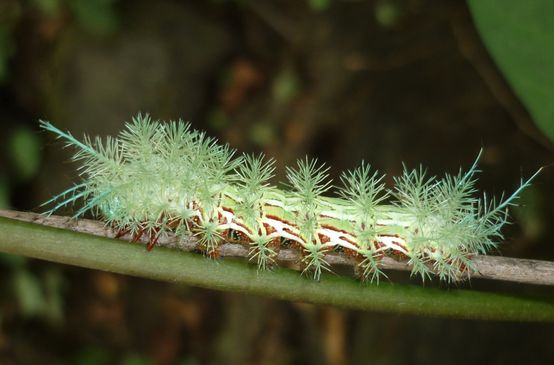
Countless other fascinating species live there, including the spectral bat (Vampyrum spectrum) – the largest carnivorous bat species in Latin America – and the butterfly Cithaerias pireta, whose transparent wings make it almost invisible. All of them are indicators of the health of the entire ecosystem.
Rainforest Rescue’s partner organization CIPBAT (Corporación para la Investigación y Protección de los Bosques de los Andes Tropicales – Society for the research and protection of tropical Andean forests) combines nature conservation with scientific research and environmental education. The goal is to study and preserve biodiversity, secure the livelihoods of the local population and, through environmental education, communicate the importance of this unique forest area for generations to come.
To this end, CIPBAT has developed a comprehensive plan for the protected forest of Los Cedros that goes far beyond protecting the Los Cedros forest area and running the research station located there, where 150 scientific studies have already been carried out.
Mineral resources such as gold, copper and other metals found in the Cotacachi area, to which Los Cedros belongs, pose a permanent threat to nature. In 2021, a major legal victory was achieved. In a landmark ruling, Ecuador’s Constitutional Court placed the rights of nature in this forest above all other activities that would violate those rights. As a result, mining was banned in Los Cedros.
The ecosystem of Los Cedros has the right to the existence of plant and animal species, and to the maintenance of their cycles, structures, functions and evolutionary processes.
– Constitutional Court of Ecuador

With environmental education as a crucial step, CIPBAT is securing the long-term protection of the forest. An environmental education project centered on the Los Cedros research station explains the importance of the forest to local people and shares knowledge gained from on-site research.
The project aims in particular to inspire the younger generation so that they value, love and protect nature. Through this program, people’s relationship with nature will be shaped in a lasting, positive way. Successfully implemented in recent years, it relies on a collaborative, hands-on pedagogy that supports the conservation of the Los Cedros protected forest.
The project’s educational methodology focuses on learning from experience based on the principle “Act – reflect – act”. Theory and practice are closely interwoven to build deep, lasting knowledge. In this way, participants are empowered to understand the environment better and to help shape it actively. The activities are age-appropriate and connect ecology, art and emotional experiences.

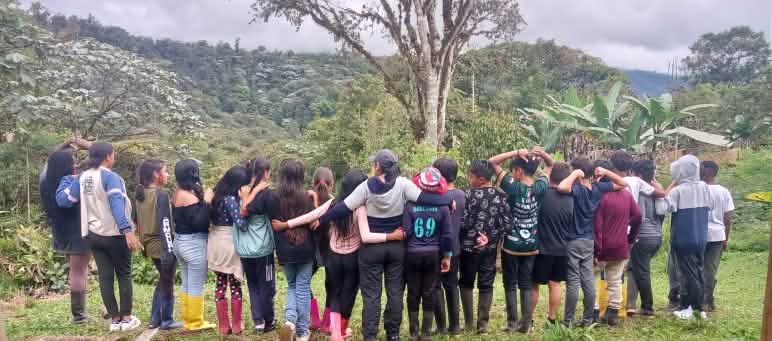
The environmental education project currently has three main components. It works with primary and secondary school students in the Los Manduriacos valley, involves teachers, parents and local authorities and thus promotes broad engagement for the protection of nature.
Presenting the Los Cedros protected forest in the classroom
The learning content is communicated using interactive methods. Group activities, games, theater techniques (for example, Theatre of the Oppressed) and playful approaches that build on students’ prior knowledge foster active and holistic learning.

Excursions into the forest
Participants visit the Los Cedros protected forest, where learning becomes a lived experience with body, mind and heart. Activities include a “treasure hunt” – an exciting scavenger hunt in the forest – and birdwatching. The staff of the research station share their knowledge of biodiversity and ecological relationships. At the heart of this work is a deep, personal connection with nature through the senses, emotions and intuition, as well as the rediscovery of traditional knowledge and spiritual perspectives in order to experience the universal bond between people and nature.
Open day
The participants of the environmental education course take on the role of teachers and facilitators. They deepen the topics covered and share their knowledge with community members, classmates, teachers and parents – whether through models, games or clear, vivid explanations.

Forest guardians
Through the training of forest guardians, people in the communities surrounding the Los Manduriacos valley receive training in aquatic ecology, the use of camera traps, mapping and knowledge of their territory, as well as in bird ecology. The aim is to involve the local population actively in conservation measures and to strengthen their expertise.
This educational and awareness-raising work is crucial to counter the ongoing threat of mining that has weighed on the region for more than three decades – and that the people of the Cotacachi region have repeatedly resisted successfully. By fostering environmental awareness and bringing communities together, the project makes a major contribution to preserving species-rich cloud forests, to climate protection and to defending human rights and the livelihoods of Indigenous and local communities.
The Los Cedros protected forest is not only a center of scientific research, with numerous insights gained, it is also a place of resistance and a stronghold for life, nature and community.
– Monserratte Vásquez, CIPBAT
Los Cedros needs you
Picture a forest in which every plant, every bird and every living being plays a unique role – a place full of life, research and hope. Your donation will help protect this forest, fund the training of forest guardians and support environmental education projects. Every contribution helps safeguard biodiversity, strengthen communities and advance climate action.

Donate now to help secure the future of Los Cedros