The indigenous Awa Guajá document their history
In territories carved out of a once-vast forest, some 600 Awa Guajá are rebuilding their community after decades of violence, while relatives remain in voluntary isolation under the canopy they protect. As freight trains thunder past, Indigenous teachers weave together land rights, climate change, children’s drawings, and elders’ stories into a powerful narrative of survival.
Project Overview
Project FocusEcosystems / Rainforest Defenders
Project Objective Ensuring that traditional peoples and communities can remain in their ancestral territories
Activities Defending their territory through communication and human rights education
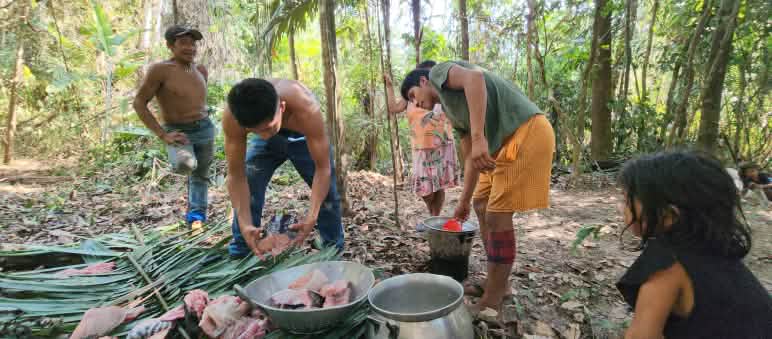
For generations, the Indigenous peoples of Brazil have protected the forests, waters, animals, and spirits in their territories through their knowledge, culture, and ways of life. The Awa Guajá also know and guard the living paths that link sky and earth, surrounded by an Amazon rainforest so high and full of giant trees that it seems to embrace the clouds. They hunt, sing, and build relationships with all living beings.
Drawing on their deep understanding of nature in all its complexity, the Awa Guajá survived for centuries by seeking refuge deep within the rainforest, avoiding colonial invaders and maintaining voluntary isolation from the outside world. During the military dictatorship from 1964 to 1985, however, they were forced to settle in government-established communities.
Survivors of a slow genocide
Today, an estimated 600 Awa Guajá live in the three officially recognized Indigenous territories of Caru (173,000 hectares), Alto Turiaçu (532,000 hectares), and Awa (117,000 hectares) in the northwest of Maranhão state. They are the survivors of a slow genocide. Around 60 more Awa Guajá continue to live in voluntary isolation in the Amazon rainforest areas that they still protect to this day.
Outside these territories, nature and its extraordinary biodiversity have been almost completely destroyed by large landowners, cattle ranchers, loggers, and mining companies.
The Brazilian government now classifies the Awa Guajá as an Indigenous people who have only recently come into contact with the outside world. As a result, they remain highly vulnerable in territorial, social, cultural, political, linguistic, and epidemiological terms.
Yet the government takes almost no action to protect them. This failure not only violates their human rights, it also threatens to erase their knowledge, culture, and traditional way of life in the rainforest forever.
The Awa Guajá raise awareness and organize
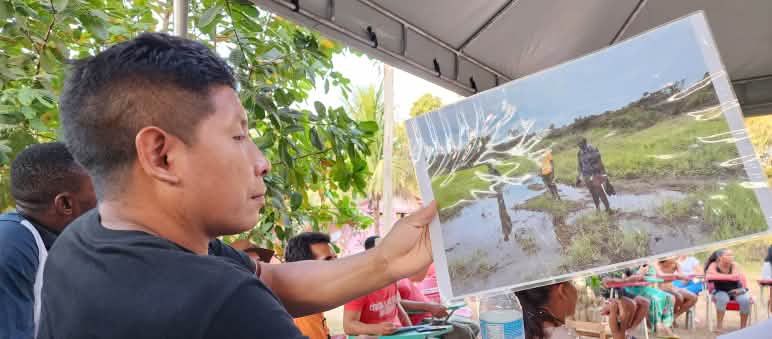
With the help of linguists, anthropologists, and lawyers, the Awa Guajá in the Caru Indigenous territory have begun to share and document their culture and way of life through articles, drawings, photos, and videos. A group of 14 Indigenous teachers brings this knowledge to villages and classrooms. These activities are made possible by donations to Rainforest Rescue.
The project also addresses topics such as territorial rights, the impacts of climate change, the organization of the Indigenous movement, the effects of economic projects such as mining, violence against Indigenous peoples, and the defense of their constitutional and internationally recognized rights. Another goal is to strengthen the political organization of the Awa Guajá and to build relationships with other Indigenous groups and state institutions.
Iron ore railway in the Amazon rainforest
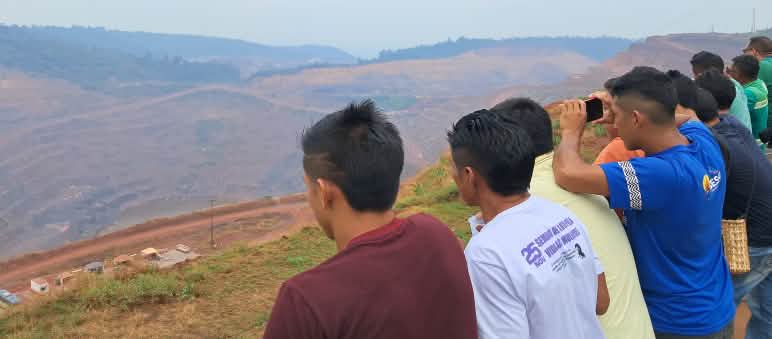
In 2025, the group of teachers visited the world’s largest iron ore mines operated by the mining company Vale and took part in a meeting of Indigenous peoples affected by mining as part of the project. The Awa Guajá now understand where the kilometer-long freight trains that endlessly rattle through their rainforest come from.
The iron ore extracted by Vale in open-pit mines in the Carajás Mountains is transported along a 900-kilometer freight railway (Estrada de Ferro Carajás) to a port on the Atlantic Ocean. The company built this railway across the Amazon in the 1980s. Ever since, the noise and the heavy-metal-laden dust rising from the open wagons have poisoned lives, polluted rivers and streams, and killed people and animals – with barely a pause.
If you would like to support the Awa Guajá people, please donate here.