Frequently asked questions about land grabbing
What does “land grabbing” mean?
Land grabbing is the partly legal, partly illegal appropriation of land by companies or state actors on a large scale. In many cases, foreign investors lease or buy fertile land and use it to produce food or energy crops, often for export. Local communities often lose their livelihoods, are displaced, or are even driven from their land. The number of land deals has risen sharply in recent years, especially in Africa.
A situation is described as land grabbing:
- when investments violate international human and minority rights,
- when they are carried out against the will of local communities,
- when they proceed without independent assessments of their environmental, social, and economic impacts,
- when they are based on opaque contracts that fail to clearly regulate the terms of land leases, labor conditions, and taxation,
- and when they are not based on democratic planning processes that include objective oversight and equal participation by all affected stakeholders.
Modern land grabbing doesn't have to involve outright lawbreaking. In many cases, these “foreign direct investments in agriculture” take place in a political environment where the rule of law and human rights and environmental legislation are weak.
That is why an international coalition of human rights and environmental organizations, farmers’ associations, and academics agreed on the conditions outlined above, which are based on and further develop the UN’s international guidelines against land grabbing.
Is land grabbing a new phenomenon?
No. Land grabbing is a historical phenomenon, directly tied to colonialism. That said, there is a difference between historical and modern land grabbing. Where colonial elites once seized vast estates and forced people to work in cotton or sugarcane fields, today’s race for farmland differs in important ways. Far more institutions are involved than in colonial times, and investments in farmland are embedded in the opaque structures of the international financial system. Modern large landowners are rarely seen on their land. Today, they sit in the glass towers of the international finance and agribusiness industries. What has not changed: it is local communities and the natural world that bear the consequences.
What triggered the new hunger for land?
Three main factors drive modern land grabbing: government subsidies for agrofuels in the United States and Europe, a sharp rise in staple food prices during the global financial crisis of 2007, and rising global meat consumption.
Government subsidies for the production of agrofuels in the United States and the EU in particular fueled this new wave of land grabbing. The legally mandated blending quotas cannot be met through the cultivation of domestic energy crops alone and therefore have to be supplemented with large quantities of imported agrofuels made from sugarcane and palm oil. This has restructured agriculture. Instead of growing food, more and more land is now being used for energy crops. That, in turn, drives up food and land prices.
The global financial and economic crisis beginning in 2007 further accelerated land grabbing. After the collapse of the financial markets, hedge funds and other major speculators moved into agricultural commodity trading on the Chicago commodity exchange. As a result, world market prices for staple foods such as rice, corn, and wheat soared, rising to more than double within a single year. Since investing in the means of production is even more profitable than investing in the products themselves, fertile farmland also became a sought-after investment.
Another factor encouraging land grabbing is the global rise in meat consumption, and with it the growing demand for pasture and farmland for the cultivation of animal feed.
Where does land grabbing happen?
The Singapore-based corporation Wilmar has planted oil palm plantations on more than 200,000 hectares in Indonesia. In Brazil and Argentina, the U.S. corporations Monsanto and Cargill grow soy monocultures across vast areas. And in the Republic of the Congo, the Italian oil company ENI is planting 70,000 hectares of oil palms in the middle of the rainforest.
Large-scale land grabbing takes place mainly in countries of the Global South, and land deals recorded since 2000 currently affect more than 203 million hectares worldwide. That is more land than the entire agricultural area of Europe. Africa is the main focus of agricultural investment. Sixty percent of global large-scale investment in industrial agriculture is concentrated there. That is an area four times the size of Germany.
Asia ranks second as a target of land grabbing. However, these areas are not spread evenly across the continent but are concentrated in certain countries. In Indonesia, for example, vast oil palm plantations cover nine million hectares – where rainforest once stood.
Large-scale investment in agricultural land also covers millions of hectares in Latin America. Above all, the huge soy monocultures in Brazil, Argentina, and Paraguay scar natural landscapes.
Who is grabbing the land?
According to the World Bank, the largest share of investors comes from investment funds and industrial corporations. Together, they account for 60 percent of all land deals worldwide. In their conventional form, neither sector specializes in agriculture. But the expectation of high returns is prompting more and more outside financiers to invest in industrial agriculture – with dramatic consequences for people and the environment.
The third-largest group of land grabbers is made up of the major global agribusiness corporations, which account for 17 percent of global land grabbing. A large share of global agribusiness is controlled by just a few companies, including Cargill, ADM, Bunge, and the Dreyfus Group. Other powerful corporations in the agricultural sector include seed and pesticide manufacturers such as Monsanto, Syngenta, Bayer, and BASF. In Argentina, an agricultural cartel made up of a few large corporations controls 85 percent of the soy sector. Typical features of this form of industrial agriculture are vast monocultures and the excessive use of chemicals and genetically modified seeds.
Alongside investment funds, industrial corporations, and agribusiness companies, state-owned companies are also involved in land grabbing. Indian and Saudi state firms, for example, leased hundreds of thousands of hectares of farmland – especially in Ethiopia. This led to the absurd situation during the East African hunger crisis of mid-2011 in which thousands of people starved while tons of flowers, fruit, and vegetables were being harvested for export in ultramodern greenhouses in Ethiopia’s Rift Valley.
Who is promoting global land grabbing?
Global land grabbing is being driven by the policies of industrialized nations, international financial institutions, and major banks, hedge funds, and insurance companies.
In mid-2008, the Guardian published a leaked World Bank report. The study shows that the agrofuel policies of the United States and the EU are responsible for exploding world market food prices and the resulting rise in global hunger. Support for agrofuel production has had three serious consequences for agriculture. In the United States, one-third of wheat production now ends up in fuel tanks rather than on plates, while in Europe the same is true for half of all oil crops. This policy has encouraged many farmers to devote a large share of their land exclusively to the production of energy crops. The direct result has been increased speculation on harvest yields and, with it, rising food prices. The increase in agricultural commodity prices prompted companies and investors to buy or lease cheap farmland in other countries in order to grow energy crops there for export.
The policies behind industrial agriculture are promoted above all by major global institutions such as the World Bank, the International Monetary Fund (IMF), the World Trade Organization (WTO), and the UN Food and Agriculture Organization (FAO). Although the World Bank published seven principles for responsible agricultural investment in 2010, they still follow market-liberal principles. These “principles” are not intended to change the rules governing investment in agriculture. Instead of strengthening the rights of local people, these institutions continue to rely on the “self-regulating forces of the market.” This approach was declared a failure as early as 2008 in the International Assessment of Agricultural Knowledge, Science and Technology for Development, compiled by 500 scientists from 86 countries. They called instead for a shift away from industrial agriculture and for support for ecologically sound smallholder farming.
Private financial institutions also play a major role in the sell-off of natural resources at the expense of the environment and human rights. Whether agricultural funds run by major banks, insurance companies, hedge funds, or pension funds – they all want a share of the profits from modern land grabbing. RCM Global Agricultural Trends, a fund run by the insurance company Allianz, for example, invests in Wilmar, the world’s largest palm oil producer. This corporation repeatedly stands out for environmental destruction and human rights violations in Indonesia.
What is the land being taken for?
According to the International Land Coalition, energy crops for the production of agrofuels are grown on 40 percent of the land affected by land grabbing. Scientists have long established that, in most cases, the climate balance of agrofuels is no better than that of fossil fuels. Plant-based fuels made from palm, soy, and rapeseed oil are just as harmful to the environment as conventional diesel.
Africa’s agriculture in particular is being restructured on a massive scale because of the agrofuel boom in the United States and Europe. Although hardly any vehicles in Africa run on agrofuels, nearly 19 million hectares on the continent are planted with energy crops. Overall, the agrofuel sector accounts for 66 percent of all current large-scale investments in African agriculture. By comparison, just 15 percent of investment goes to food production.
In Latin America, food production ranks first, accounting for 27 percent of all investment. The bulk of this consists of huge soy monocultures. Ninety-seven percent of this soy is used as animal feed and primarily supports factory farming in Europe and the United States. To meet Germany’s soy imports, 2.6 million hectares of farmland are needed in South America. An area larger than Mecklenburg-Western Pomerania.
Alongside energy crops and the cultivation of food and feed crops, the forestry industry is the third-largest purpose behind land deals. Timber plantations occupy enormous areas of land where natural forests or other important ecosystems once stood. These are usually vast industrial monocultures of exotic trees such as eucalyptus, pine, and teak. While the plantations supply large quantities of cheap, uniform timber for industry, they serve no ecological or social function. That is why they are also described as “green deserts.”
What impact does land grabbing have on nature?
Scientists have exposed the lies of land grabbers. Investors usually claim that monocultures are grown only on unused or “degraded” land and therefore do not cause environmental damage.
Using satellite imagery, scientists found the opposite. Their findings show that fertile farmland and forest areas are the most affected by land grabbing. One-third of land deals have negative impacts on natural forests and therefore cause significant environmental damage. Forests are cleared for monocultures, releasing CO2 and destroying biodiversity. For investors, this pays twice over. They profit first from the sale of the timber and later from growing oil palms, soy, or sugarcane.
Monocultures in industrial agriculture harm both people and the environment. One-sided cultivation and limited crop rotation alter the ecological balance of soils. Monocultures are also highly vulnerable to diseases and pests. To prevent soil erosion and pest infestations from reducing yields, monocultures must be intensively treated with both synthetic fertilizers and pesticides. Over time, these chemicals poison the soil, groundwater, wild plants in the surrounding area, and the local population.
Another negative development in industrial agriculture is the growing spread of genetic engineering, in the form of so-called GMOs, genetically modified organisms. Seed that is supposedly designed to increase yields is already causing considerable environmental harm and poses immense risks if it continues to spread.
Another aspect that often receives too little attention is the negative impact of land grabbing on regional water resources. Industrial agriculture is responsible for 70 percent of global water consumption. To guarantee yields from monocultures, plantations must be irrigated artificially on a large scale – especially during dry periods. Intensive irrigation affects the regional water balance, leaving local communities with less water for their own farming and food production.
What impact does land grabbing have on people?
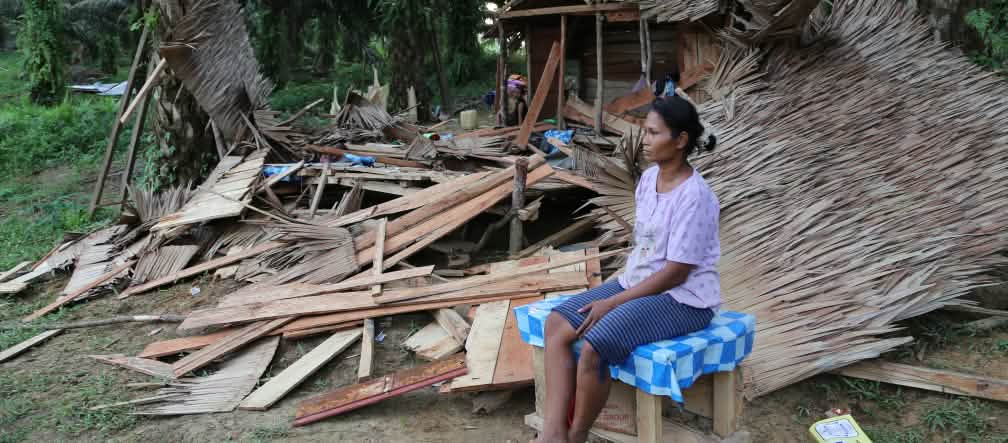
Land grabbing leads to hunger, poverty, and violence. Nearly half of all land deals involve fertile farmland – land on which food production for local communities is displaced by export-oriented monocultures. People lose their food security. Their traditional small-scale farming, which usually features high biodiversity and soil-conserving techniques, is displaced by vast industrial farms. As a result of this new wave of land appropriation, most farmers lose their livelihoods. The result is poverty and hunger.
The argument that these investments benefit society as a whole through tax revenues is true in only a very few cases. These vast, highly mechanized plantations provide few jobs, and those jobs are often poorly paid. Lease payments and taxes for investors are set so low in opaque contracts that the economies of the target countries benefit only marginally.
Because of the many harmful consequences of land grabbing, resistance is growing among the communities affected by large-scale investments. States and corporations repeatedly try to crush local protests against land grabbing through violence. As global land deals increase, so does the number of social conflicts.
Does land grabbing only occur in connection with industrial agriculture?
No. Land grabbing is also linked to other major economic projects. In Latin America, mining projects account for 23 percent of land dispossessions. Indigenous groups in Ecuador and Peru are losing their ancestral land, where they have lived for thousands of years, because of oil and gas extraction. In Brazil, tens of thousands of people are being resettled against their will for vast dam projects.
What measures must be taken against land grabbing?
Government support for so-called “biofuels” must be ended
To curb hunger, poverty, and environmental destruction, the one-sided global support for industrial agriculture must end. Seventy percent of the world’s population is fed by smallholder farming. What is needed, then, is local rather than global strategies to improve agricultural production. Better farming methods, often simple technologies, suitable seeds, and agroecological knowledge for smallholder farmers are the best way to feed people and protect the environment.
The rights of smallholder farmers and Indigenous groups must also be strengthened. Not only on paper, but through concrete measures. Full recognition of customary land rights, the granting of land titles, and the legally binding right of local communities to have a say in economic projects must be anchored in law nationally and internationally and be enforceable in court.
To protect primary and secondary forests, other sensitive ecosystems, and biodiversity, there must be binding international rules that prohibit encroachment into these natural areas and provide for firm and meaningful penalties when they are violated.
What can I do about land grabbing?
Everyone can take action against land grabbing. Ask your bank, your insurance company, or any other institution where you invest your money how those funds are being invested. Avoid investments in agricultural or commodity funds.
Support environmental and human rights organizations in their work. You can sign petitions or strengthen that work with a donation. And speak to people around you about the reality of land grabbing.
