Guilty! “People’s Court” imposes symbolic sentence on mining companies
Brazil: At the Peoples’ Summit, held alongside the COP30 World Climate Conference in Belém, organizations and Indigenous peoples conducted a symbolic trial. They publicly denounced human rights and environmental crimes committed by Brazil’s mining industry. Rainforest Rescue took part.
This is a historic day, because even if our tribunal has no legal effect on the mining companies and the state, their crimes are real and happening right now,” summarized João Gomes, a member of the organization FASE Amazônia, at the end of the three-hour session.
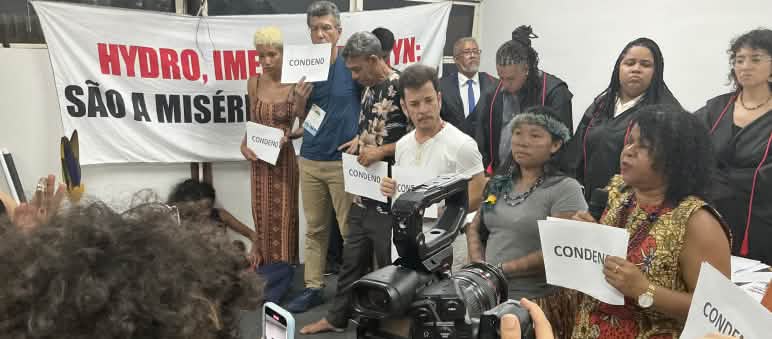
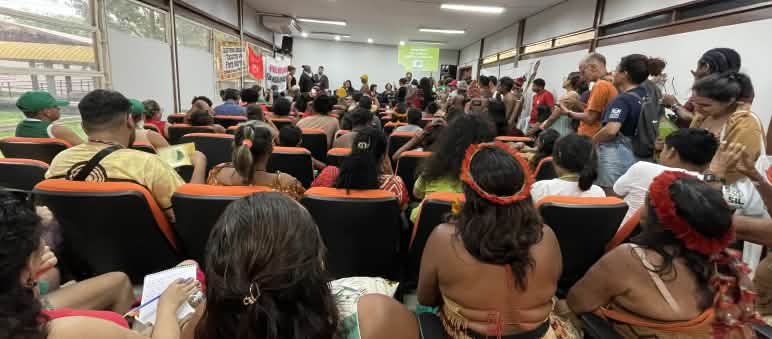
In a “People’s Court” held in a lecture hall at the Federal University of Pará (UFPA), environmental and human rights groups conducted a public and symbolic trial on November 13 to defend the Amazon rainforest and the rights of its inhabitants. The event took place as part of the Peoples’ Summit, held in mid-November alongside the international UN Climate Conference COP30 in Belém, Brazil.
The goal: To symbolically judge the violations and crimes against people, land, water, and climate reported by Indigenous peoples and traditional communities.
The “defendants”: The four mining corporations Vale, Belo Sun, Hydro, and Imerys-Artemyn, as well as the institutions of the Brazilian state of Pará, which have failed in their duty to protect the rights of people and nature.
Members of civil society assumed the roles of judge, court clerk, witnesses, and advocates representing the victims, the companies, and the state. There were also international observers and a five-member jury.
Rainforest Rescue actively participated in the proceedings: activist Guadalupe Rodríguez served as an international observer, and our colleague in Brazil, Felipe Duran, was part of the jury. The panel also included Ediene Kirixi Munduruku, a member of the Indigenous Munduruku people and a partner of our organization. More than one hundred people attended the session, including dozens of Indigenous Munduruku.
The “People’s Court” could issue only an opinion, since it is not part of Brazil’s official judicial system. Its verdict therefore has no legal effect on those convicted – they cannot be sentenced to prison, fined, or ordered to pay compensation.
The symbolic trial is an important tool for Indigenous peoples and communities to protect their land, their livelihoods, and their rights,” explains Guadalupe Rodríguez. “The People’s Court gives those affected a voice and visibility, drawing public attention to the negative impacts of the mining companies on people and the environment.”
The proceedings gave affected people a platform to speak freely, report violations and crimes, strengthen their rights, and reaffirm their dignity. The trial also exposed both the complicity and the inaction of the government and state institutions.
Through this process, we show our solidarity with the people, we stand with them, and we take a clear position,” says Felipe Duran.
Powerful accusations
For nearly three hours, ten witnesses – including Indigenous people, Afro-Brazilian Quilombolas, and smallholders from areas affected by mining – gave moving testimony about the violence they have endured. Some of the abuses began in the 1970s and have continued for more than 40 years.
They spoke of how rainforests, streams, and rivers were destroyed, how waters were polluted, and how people have been poisoned by toxic waste from mining companies – including mercury and heavy metals – that enter the springs and streams the communities rely on for drinking, cooking, and bathing.
Time and again, victims testified that there had been no prior, free, and informed consultation or consent from the communities before the companies and the government launched mining projects on their lands. Convention 169 of the International Labour Organization (ILO) of the United Nations (UN), which Brazil has ratified, mandates such consultation for Indigenous peoples and traditional communities.
Afro-Brazilian and Indigenous women are particularly affected by the violence resulting from mining. They not only suffer from contamination and illness caused by mining but also care for others who are affected, including children and the elderly. They are also among the most outspoken in resisting injustice.
It is always the face of a Black woman that stands at the forefront of these struggles, and men need to recognize that we are the stronger force, that we do not give up, that we always care,” said Antônia Flávia, a resident of Piquiá da Conquista in Açailândia, Maranhão.
Because of the pollution and illness caused by the Vale corporation in her traditional territory since the 1980s – and later by the steelworks built there – the young woman, her family, and hundreds of others were forced to leave their homeland.
Violence and criminalization
The mining companies faced serious accusations during the hearing, including forced evictions, destruction of homes, arson, death threats, and moral, sexual, and legal harassment, as well as violations against communities and local leaders.
Lengthy and costly lawsuits are another tactic companies use to criminalize and silence local residents. Among the Indigenous Munduruku present in the hall, more than ten people had received death threats. A similar number were facing court cases and defamatory police reports intended to violate their dignity, intimidate them, and make them targets for further attacks and even physical assaults threatening their lives.
Allegations against the mining companies

The Brazilian mining corporation Vale primarily extracts iron ore. Its mining and industrial sites, railways, and ports have caused severe disasters, such as the tailings dam collapses near Mariana in 2015 and Brumadinho in 2019. These tragedies claimed hundreds of lives and devastated forests and rivers over hundreds of kilometers. In addition to these major disasters, witnesses said, Vale is responsible for daily violence and numerous crimes in the states of Maranhão, Pará, and Minas Gerais.
The Canadian company Belo Sun plans to build Brazil’s largest open-pit gold mine on the Xingu River. Luiz Teixeira, a member of the Xingu Vivo para Sempre movement and a longtime partner of Rainforest Rescue, testified against Belo Sun. He presented remains of burnt wood from the home of a small farmer whose house had recently been set on fire. According to Luiz, the farmer lives in a settlement on land in Pará where Belo Sun intends to mine gold. This and many other acts of violence are linked to the company, he said.

The semi-state Norwegian mining company Hydro not only clears Amazon rainforest to mine bauxite but also contaminates ecosystems and local communities with industrial pollution and toxic waste. From bauxite, Hydro produces aluminum oxide at its Alunorte refinery near Belém at the mouth of the Amazon River – which it calls the world’s largest – and raw aluminum for export at the adjoining Albras plant. In 2018, a major toxic spill from one of its dams contaminated waterways in the municipality of Barcarena. That same year, researchers found a pipeline through which Hydro discharged untreated wastewater into springs feeding a river in the same area, according to several accounts.
The French company Artemyn-Imerys, now part of the British Flacks Group, has also been blamed for destruction and violence in the Amazon. The company mines kaolin used in the production of cement, paper, ceramics, and other materials. Artemyn-Imerys reportedly buried mining pipelines stretching for hundreds of kilometers under rainforest soil and Indigenous land, destroying forests and polluting rivers and streams. The company employs private security guards accused of attacking local residents.
The state of Pará and its environmental authorities, such as the State Secretariat for the Environment, were accused of negligence, issuing illegal environmental licenses, and tolerating acts of violence and crimes committed by the companies.
There is no seller without a buyer. That is why I believe this symbolic court could be extended to international law, to hold European and other countries such as Canada and China accountable for sourcing these raw materials produced through environmental destruction and violence,” stated Guadalupe Rodríguez of Rainforest Rescue in her testimony as an international observer.
Unanimous “conviction”
All the companies and the state of Pará were unanimously found guilty of the crimes and violations reported by the witnesses:
In the case of the state of Pará, an aggravating factor is that it is obligated to ensure compliance with the laws and the general well-being of the population. Through its actions or inaction, the state has chosen to enable the projects and thus the crimes and violations presented,” explained our Brazilian colleague Felipe Duran while reading the verdict.
In her symbolic ruling, “Judge” Jéssica da Silva Santos “sentenced” Brazil, the state of Pará, and the accused companies to provide reparations to the victims of environmental crimes and the climate crisis, and to take measures for climate justice and mitigation. She also ruled that the state of Pará must monitor the companies, impose fines transparently, and that Brazil and the state of Pará must suspend all projects carried out without the prior consultation and consent required by ILO Convention 169. The “judge” further ordered that the territories of Indigenous peoples and Afro-Brazilian communities be demarcated and recognized without delay.
The verdict was forwarded to the COP30 presidency, the Brazilian government, federal and state prosecutors, public defenders, the UN, the OAS, all participating countries and embassies, as well as civil society organizations, the press, and affected peoples and communities.
Along with FASE and Rainforest Rescue, the event was organized by the research group “Society, Territory and Resistance in the Amazon” (GESTERRA) of the Federal University of Pará, the People’s Movement for Mining Sovereignty (MAM), the Indigenous Munduruku people, and Afro-Brazilian Quilombola and traditional communities from Pará and Maranhão.
This page is available in the following languages:
Rainforest protection is not a profit machine: Stop the TFFF!
Rainforests do not belong in the hands of investors: The Tropical Forests Forever Facility (TFFF) must be stopped immediately.
Life for the Xingu River in Amazonia
Where the Xingu bends through the rainforest, people are rising up to protect the waters that have sustained them for generations.

Preserving Latin America’s diversity
The Amazon region is home to the largest and best-known rainforest on the planet. It plays a crucial role in the Earth’s climate system.
Aluminum
Yoghurt lids, beverage cans, deodorants – aluminum is everywhere. Mining its raw material, bauxite, destroys vast tracts of forest and other land.