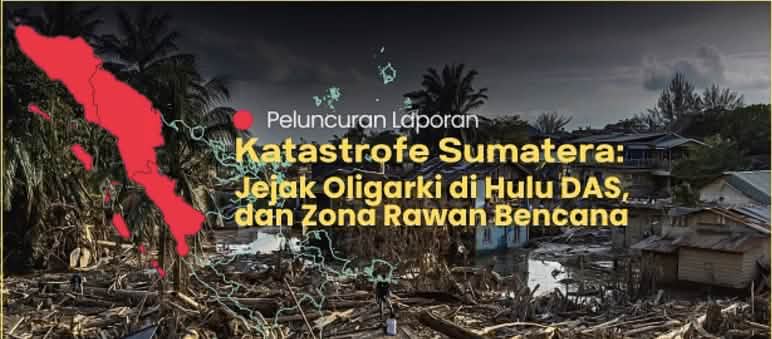
Sumatra: government shuts down dozens of destructive companies
Indonesia: Two months after Cyclone Senyar hit Sumatra, permits for the dam and hydropower plant in the Batang Toru forest have been revoked with immediate effect. The Martabe gold mine, the pulp company Toba Pulp Lestari, and 25 other firms must also shut down. The Indonesian Secretary of State announced the decision at a high-profile press conference.
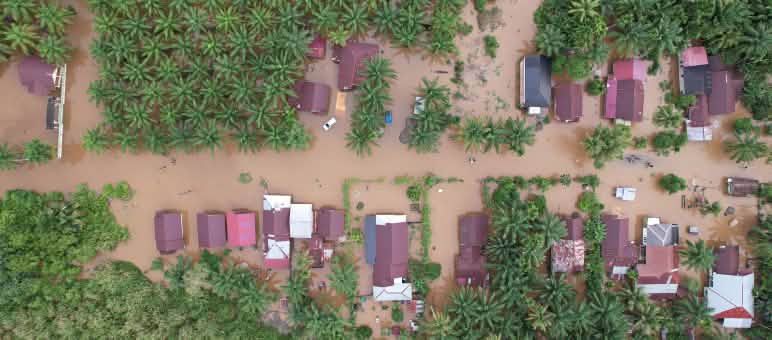
In the wake of Cyclone Senyar on November 25, 2025, and its devastating impact on Sumatra that was made far worse by massive deforestation and environmental destruction, numerous companies in the three affected provinces of Aceh, North Sumatra, and West Sumatra were finally subjected to government review.
The result: numerous companies were operating outside the law. President Prabowo Subianto ruled that 28 companies must shut down. This was announced by State Secretary Prasetyo in a press conference broadcast via livestream on January 20, 2026, almost two months after the cyclone.
These include the pulp company Toba Pulp Lestari, the hydropower plant and the Martabe gold mine in the Batang Toru forest, and the logging company SPS on the Mentawai Islands. The list of companies can be found below. Unless otherwise noted, they are logging companies.
The “hydrometeorological disaster” (Prasetyo) accelerated the review of companies that profit from exploiting nature. Despite this wording, the government does not define the situation as a national disaster, with the result that virtually no government disaster relief has been forthcoming. Emergency aid is provided mainly by civil society, supported in part by donations to Rainforest Rescue.
“1,190 people have died, 141 are still missing, and 131,000 are still living in refugee camps and tents. 175,000 houses, as well as many roads and bridges, have been destroyed. Social and economic life has come to a standstill,” report the organizations JATAM, APEL, and KSPPM, describing the devastating consequences of the storm as “the trail of destruction left by the oligarchy in the upper reaches of the rivers and in earthquake zones” (PDF in Indonesian: Jejak Oligarki di Hulu DAS dan Zona Rawan Bencana, with maps and graphics showing corporations owned by politicians or in which they hold shares).
Paper industry and hydropower
The fact that twelve logging companies in North Sumatra have lost their operating licenses is a ray of hope for the battered rainforest of the province. Local people are particularly relieved that the pulp company Toba Pulp Lestari, which belongs to the APRIL holding, must finally cease operations.
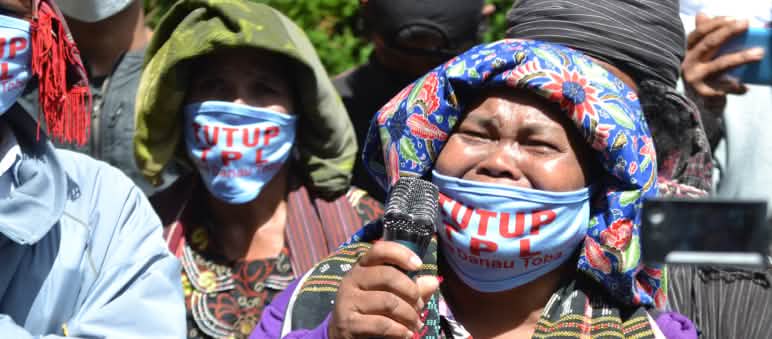
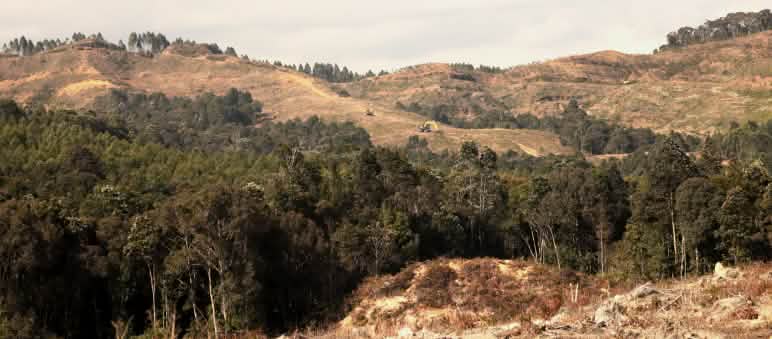
“Shut down Toba Pulp Lestari” has been the rallying cry for local communities in recent years, as the company’s eucalyptus plantations and the pulp mill are now encroaching on the Batang Toru forest. For forty years, Toba Pulp Lestari has been destroying the rainforest, robbing the Indigenous Batak of their ancestral land, poisoning rivers and Lake Toba, and repeatedly resorting to violence. Only recently, armed men once again attacked a village.
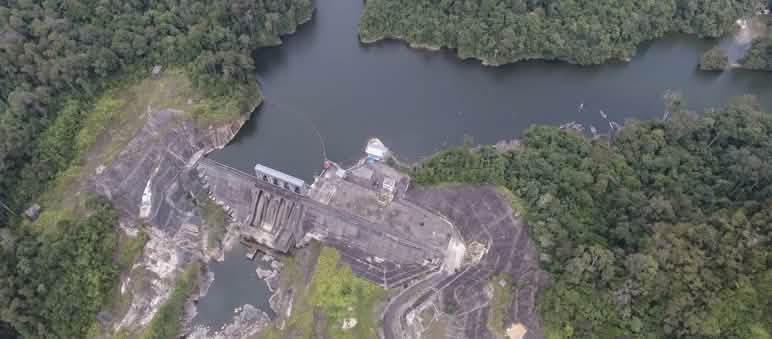
The dam and power plant in Batang Toru forest, home to critically endangered Tapanuli orangutans, tapirs, Sumatran tigers, and other protected wildlife species, must not be built any further. The impact of the cyclone was particularly severe in this region. Along the Batang Toru River, 350 hectares have been cleared for the hydropower plant.
Clear-cutting for the Martabe gold mine operated by PT Agincourt Resources has also caused extensive damage. The 130,252-hectare concession overlaps with the Batang Toru ecosystem. The company has destroyed more than 700 hectares of forest.
Sanctions only on paper?
“Experience so far shows that without public pressure, revoking permits remains little more than symbolic politics,” warns Rianda Purba, director of our partner organization WALHI North Sumatra. “The close ties between the oligarchy and the government accelerate environmental destruction and heighten the risk of ecological disaster,” Rianda Purba stated in the Indonesian press release “Symbolic revocation of permits for environmentally destructive companies is dangerous.”
“Revocation must tackle the root of the problem and be paired with real solutions. It is not enough to revoke companies’ permits while conflicts, environmental damage, and social impacts in affected areas remain unresolved,” says Rahmat Syukur of our partner organization APEL in a joint statement with Trend Asia and YCC Mentawai, “The companies responsible for the disaster must restore nature” (in Indonesian, in WALHI Sumut’s press release).
Sumatra’s environmental defenders call on policymakers:
- Companies must not be allowed to keep exploiting natural resources without a license, as has often been the case until now.
- The revocation of permits must be final.
- The government must enforce the law and penalize violations.
- Companies must work with local communities to resolve land rights conflicts.
- Above all, they must restore degraded land.
For years, Rainforest Rescue has been advocating for the protection of the Batang Toru forest, the habitat of the Tapanuli orangutan, and for the forest rights of Indigenous communities, through joint campaigns and the petition “Stop bulldozing the Tapanuli orangutan”.
Rainforest Rescue is part of the broad “Shut down Toba Pulp Lestari” coalition (Tutup TPL!), providing information and the petition “Stop APRIL, Indonesia’s ruthless paper and pulp giant”.
Rainforest Rescue also supports several Indigenous communities in preserving and reforesting their woodlands on the shores of Lake Toba and in the forest of the Tapanuli orangutans.
According to data from partner organization Forest Watch Indonesia, the neighboring province of Aceh has lost 1,770 km² of forest – an area larger than Greater London, or 1.5 times the size of New York City – over just the past seven years. Four logging companies bear the main responsibility. Three of them have now had their operating licenses revoked: PT Aceh Nusa Indrapuri, PT Rimba Timur Sentosa, and Rimba Wawasan Permai, incidentally not for the first time. The fourth, PT Aceh Nusa Indrapuri, which is part of the president’s own corporate empire, remains untouched.
The Leuser ecosystem, the unique area where Sumatran orangutans, tigers, elephants, and rhinos share the same habitat, wetlands – peat bogs, mangroves, swamps – are a key focus of Rainforest Rescue’s work. Yet the countless palm oil plantations, especially those in the protected Tripa peat swamp, the preferred habitat of Sumatran orangutans, are not affected by Prabowo Subianto’s decision. To this day, global food corporations still source palm oil from these protected areas.
Gold mining and other forms of mining also pose a severe threat to the Leuser ecosystem. Legal and illegal mines carve deep scars into the forest and into the lives of Indigenous communities. Rainforest Rescue supports Indigenous people in Beutong in their struggle against mining, and the “Tigers of Pining” in the Gayo Highlands with a tree nursery project.
In West Sumatra six logging companies have lost their concessions, including PT Biomass Andalan Energi. This company is planning extensive logging on the Mentawai island of Sipora.
For years, Rainforest Rescue has supported the demands of the Indigenous people of Sipora island to deny the company SPS a permit, through a petition. This has been successful so far, as the environmental impact assessment has not been completed.
Companies shut down in North Sumatra
- PT Toba Pulp Lestari Tbk (pulp and viscose, eucalyptus plantations)
- PT Agincourt Resources (Martabe gold mine, Batang Toru)
- PT North Sumatra Hydro Energy (Batang Toru hydropower plant)
- PT Anugerah Rimba Makmur
- PT Barumun Raya Padang Langkat
- PT Gunung Raya Utama Timber
- PT Hutan Barumun Perkasa
- PT Multi Sibolga Timber
- PT Panei Lika Sejahtera
- PT Putra Lika Perkasa
- PT Sinar Belantara Indah
- PT Sumatera Riang Lestari
- PT Sumatera Sylva Lestari
- PT Tanaman Industri Lestari Si
- PT Teluk Nauli
Companies shut down in Aceh province
- PT Aceh Nusa Indrapuri
- PT Rimba Timur Sentosa
- Rimba Wawasan Permai
- PT Ika Bina Agro Wisesa (palm oil)
- CV Rimba Jaya (outdoor)
Companies shut down in West Sumatra
- PT Biomass Andalan Energi (timber plantation and power plant on Mentawai)
- PT Perkebunan Pelalu Raya (palm oil)
- PT Inang Sari (palm oil)
- PT Minas Pagai Lumber (on Mentawai)
- PT Bukit Raya Mudisa
- PT Dhara Silva Lestari
- PT Sukses Jaya Wood
- PT Salaki Summa Sejahtera (on Mentawai)
According to information from the anti-mining network JATAM: https://jatam.org/id/lengkap/Panja-Alih-Fungsi-Lahan-DPR-Pahlawan-Kesiangan-Bencana
This page is available in the following languages:

Protecting the Tapanuli orangutan forest
From pulp plantations to thriving forests: Villages are reclaiming their ancestral lands and proving that nature heals when Indigenous people lead.

Defending rainforests in Southeast Asia
The forests of Southeast Asia are the last refuge and habitat of orangutans, Sumatran tigers, birds of paradise and Komodo dragons.
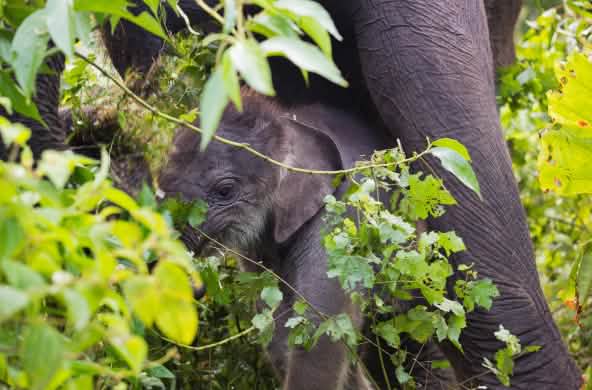
Protect Leuser's iconic wildlife!
The Leuser Ecosystem is the only place where orangutans, tigers, elephants and rhinos share a habitat. But a new land use plan could open it.

The rainforest
A green sea of ferns, mosses, vines and ancient trees. Iridescent butterflies and colorful birds. Flowers in every hue of the rainbow. The “green lung” is a natural wonder of the world. Find out more about the world’s most diverse, fascinating and threatened ecosystem.