Brazil: we need fertile farmland, not industrial timber plantations!
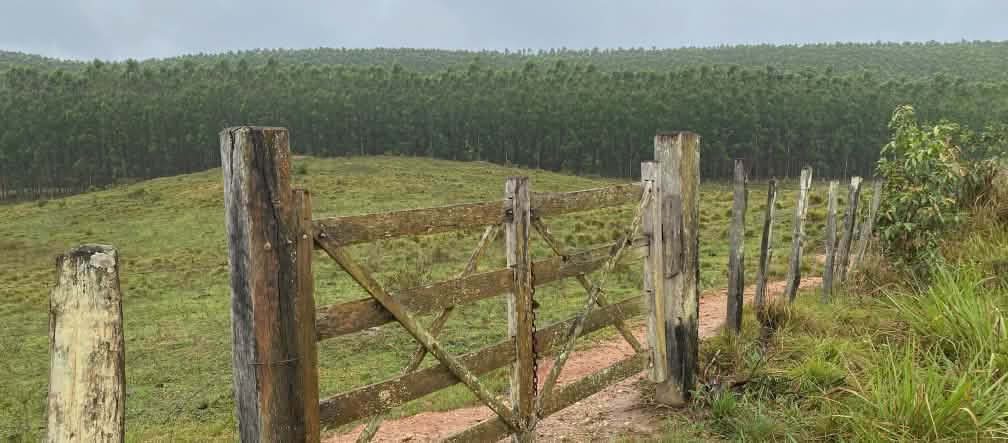
Pulp giant Veracel took over public land and planted eucalyptus monocultures – displacing rainforests, farmland, and communities. Small farmers from the MLT movement have been reclaiming that land since 2008. Courts sided with them. Yet they are still waiting for authorities to let them farm every hectare that is rightfully theirs.
News and updatesTo: the Governor of the State of Bahia, Jerônimo Rodrigues; the Secretary of State for Rural Development of the State of Bahia, Osni Cardoso de Araújo
“Evict unauthorized occupants from the land awarded to MLT and provide drinking water, electricity, and housing.”Our consumption of printer and hygiene paper has devastating consequences in tropical countries. EU countries alone import more than 10 million tons of pulp from Brazil every year – and producing that volume requires around one million hectares of eucalyptus plantations.
Rainforests and farmland are cleared, and communities are displaced, to make way for the paper industry’s destructive timber monocultures. These plantations are ecological deserts – places where other plants and animals cannot survive. Herbicides, fungicides, and insecticides are used to wipe out almost all life.
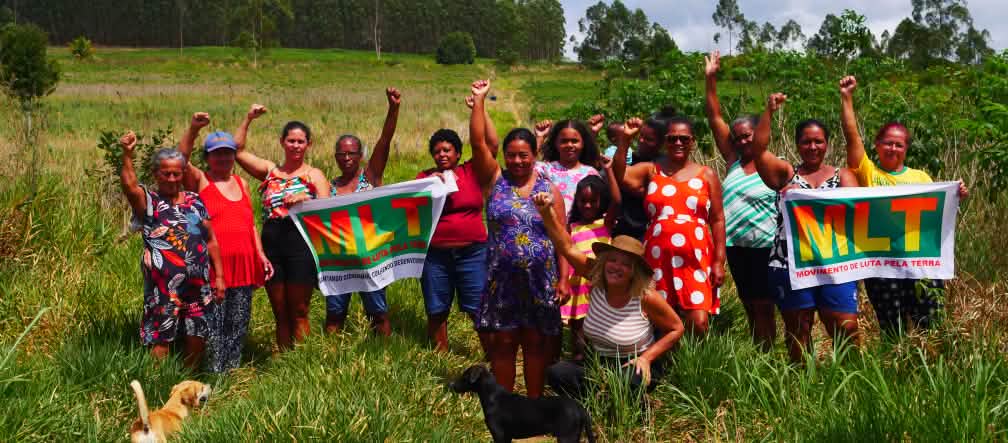
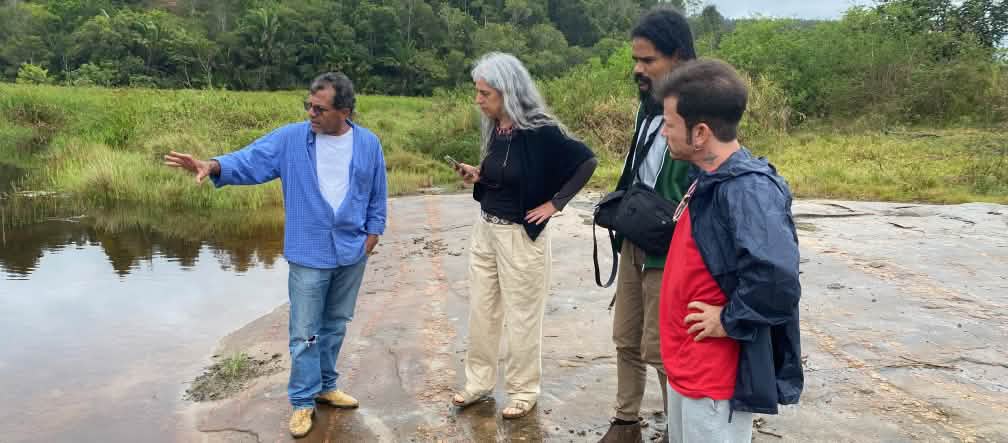
Companies frequently seize land belonging to Indigenous peoples or small farmers, or public land. In late 2025, we visited the small farmers of the Baixa Verde settlement in the Brazilian state of Bahia. In 2008, dozens of families from the MLT movement occupied 1,300 hectares of former public land that the pulp company Veracel had taken over for eucalyptus plantations.
Veracel, a joint venture between the Finnish-Swedish company Stora Enso and Brazil’s Suzano Group, initially had the settlement’s residents violently evicted. Courts and public authorities later granted the small farmers the right to use the land.
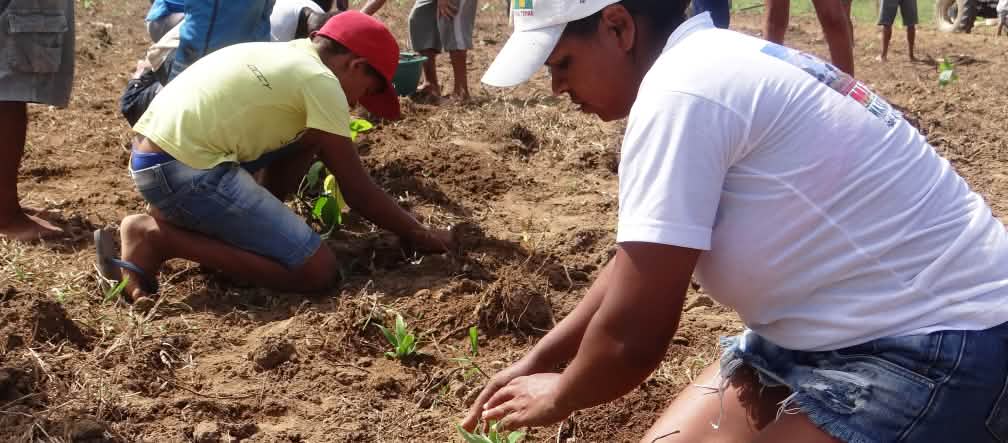
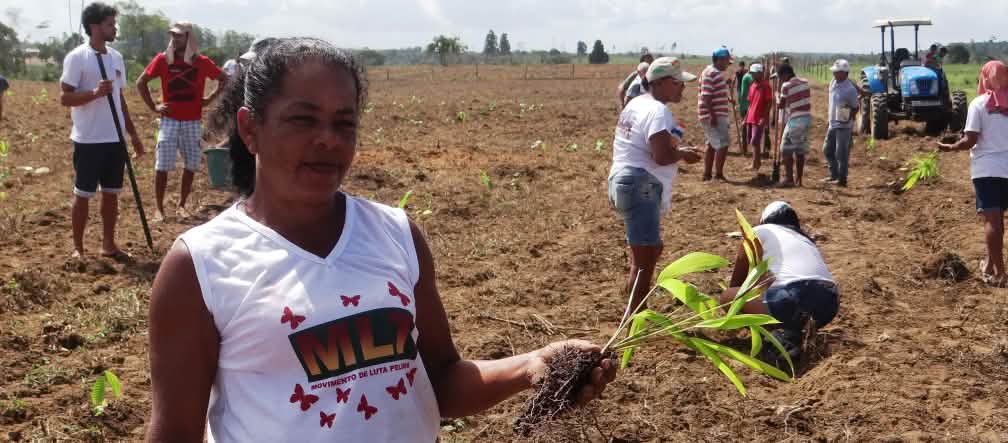
The families returned and began growing food such as cassava, bananas, and sweet potatoes. In ecologically sensitive areas, including riverbanks, they are once again planting trees and restoring rainforest.
Yet the families are still waiting for the authorities to remove unlawful occupiers so they can work all the hectares awarded to them, and to secure access to drinking water, electricity, and housing.
They have asked us to support them with this petition to the authorities.
Start of petition: 12/03/2026
Chronology of the Baixa Verde land conflict, as documented by MLT
- In 1997, Veracel reportedly acquired the land through a swap with another plot in the Eunápolis district and planted it with eucalyptus.
- In 2008, MLT activists reviewed land registry documents and found that the vast tract was in fact public land. They occupied parts of it and began growing food.
- In 2009, a court eviction order obtained by Veracel removed the small farmers, who spent months in a makeshift camp on the edge of a nearby road.
- Later that year, a state commission classified 1,300 hectares as public wasteland. The MLT small farmers occupied the land again.
- Over the following twelve years, the conflict dragged on. It intensified when a separate group occupied parts of the land, exposing the MLT small farmers to escalating violence, property destruction and arson.
- In 2021, the state government divided the land between the two groups, granting 61 MLT families usage rights to individual plots.
- Fifteen of those plots could not be handed over – they were still occupied by others.
- In 2023, a court ruled in favor of MLT members and ordered the state government to enforce the eviction of those 15 unlawfully occupied plots.
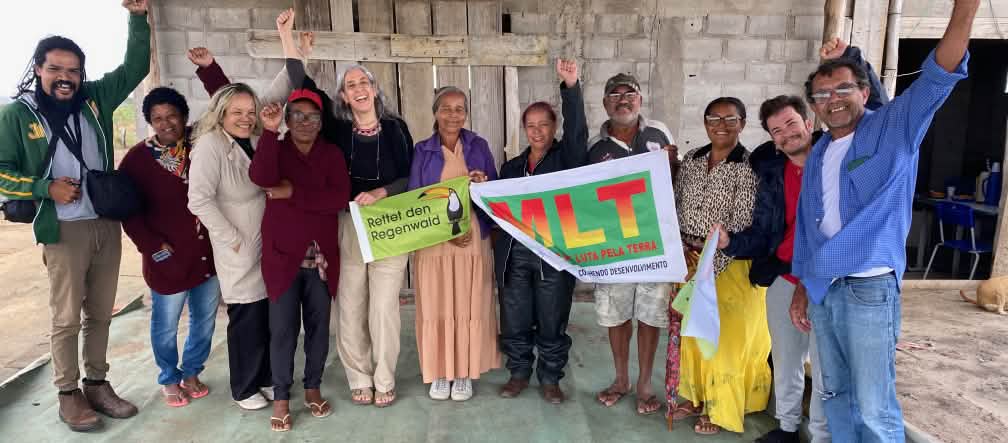
- October 2025: Three Rainforest Rescue activists visited Baixa Verde. Here is our report.
- As of March 2026, the authorities have yet to clear the plots and the land conflict continues to smolder. Commitments made alongside the land allocation – drinking water, electricity and support for housing construction – remain unfulfilled.
Land conflicts in Brazil
Land in Brazil is distributed with extreme inequality. Speculators, large landowners and corporations seize vast tracts from Indigenous peoples and traditional communities by force. The result: thousands of land conflicts are fought every year, with hundreds of people injured and dozens killed. The Pastoral Land Commission CPT documents this annually in its reports on land conflicts in Brazil (2024 edition here), and the Indigenous Missionary Council CIMI tracks the same reality in its reports on violence against Indigenous peoples in Brazil (2024 edition here).
The MLT small farmers in Baixa Verde face these threats firsthand. Six of them are under the protection of Brazil's national program for human rights defenders, journalists and environmentalists.
Land grabs and destruction driven by our paper consumption
Veracel’s activities in Brazil are directly tied to our paper use in the Global North. Each year, the company produces 1.1 million tons of pulp from its plantations, most of it for export. Eucalyptus fibers are used mainly for printing and writing paper, as well as hygiene products such as toilet paper, tissues, and diapers – everyday items whose true cost rarely appears on the label.
Europe’s economic interests run deep. The public European Investment Bank (EIB) financed Veracel with two loans: $30 million in 2001 to establish 26,200 hectares of eucalyptus plantations, and $80 million in 2003 to build Veracel’s pulp mill in Bahia. In both cases, ecological, social, and legal standards clearly counted for little.
Further reading
- The Guardian, Nov. 25, 2025. ‘Green desert’: the farmers winning a battle with Brazil’s wood-pulp giant
To: the Governor of the State of Bahia, Jerônimo Rodrigues; the Secretary of State for Rural Development of the State of Bahia, Osni Cardoso de Araújo
Dear Governor Jerônimo Rodrigues,
Dear Osni Cardoso de Araújo, Secretary of State for Rural Development of the State of Bahia,
The Baixa Verde settlement lies in an area occupied in 2008 by the land rights movement Movimento de Luta pela Terra (MLT), in the far south of Bahia – a region long marked by land conflicts and the expansion of eucalyptus monocultures driven by the international pulp industry.
This development model, which serves countries in the Global North, has had severe ecological and social consequences for the state’s traditional peoples and communities: water scarcity, soil degradation, biodiversity loss, the displacement of traditional communities, and deepening inequality in rural areas.
In 2010, the MLT settlement was assaulted by a group that seized parts of the land. MLT members resisted and continued producing food and restoring the environment.
In 2023, after the State of Bahia brought the case before the Brazilian courts, the judiciary ordered the removal of the unlawful occupiers and resolved the land dispute in favor of MLT, so its members could finally gain access to their land.
The State of Bahia has still not implemented that ruling. Residents of the MLT settlement remain unable to work all the land awarded to them. The state has abandoned them.
In light of this situation, we call on the State of Bahia to take the following steps:
- Implement the 2023 court ruling immediately and definitively, and release the areas allocated to MLT within the Baixa Verde settlement in consultation with its members.
- Urgently fulfill the infrastructure commitments made by the State of Bahia. This includes, as a priority, a reliable supply of drinking and irrigation water, electricity, housing construction, improved access roads, community facilities, and other essential services.
- Formalize, institutionalize, and implement specific public policies for the Baixa Verde MLT settlement, including support for agroecological production, ongoing technical assistance, rural credit, rural education, health care, environmental protection, youth policy, and the strengthening of the rural economy.
Yours faithfully,

European Investment Bank (EIB), accessed Dec. 3, 2025. Veracel Pulp Mill Project, Brazil: https://www.eib.org/en/press/topical-briefs/all/veracel-pulp-mill-project-brazil