Brazil: turning ‘green deserts’ into fertile farmland and forest
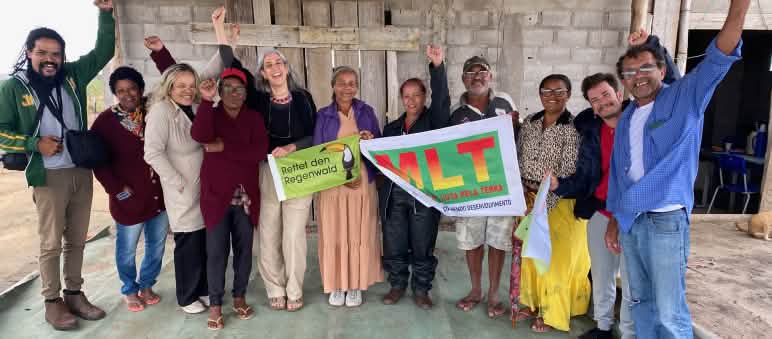
Brazil: The pulp and paper industry has covered vast stretches of land with eucalyptus plantations. We visited the Baixa Verde settlement in the Brazilian state of Bahia – built by residents and members of the MLT movement on land that the Veracel group had unlawfully seized. Today they grow food there and are replanting rainforest trees.
In late October 2025, three Rainforest Rescue activists visited the Baixa Verde settlement in the Brazilian state of Bahia. More than 60 small farmers from the Movimento de Luta pela Terra (MLT) have been struggling for 18 years against the pulp and paper company Veracel and the Brazilian state. The dispute is over the recognition of more than 1,300 hectares of land.
Veracel, a joint venture between the Finnish-Swedish Stora Enso Group and Brazil’s Suzano Group, runs industrial eucalyptus monocultures across nearly 1,000 square kilometers in the state of Bahia. The company had apparently appropriated public land unlawfully, as documents in public archives and a commission of the state of Bahia have confirmed. In addition, in legal proceedings the plots were recognized as public property.
The land conflict has remained unresolved for almost 20 years

In 2008, the small farmers moved onto the land for the first time. On the few areas not covered by eucalyptus monocultures, they began growing staple crops. At the same time, they called on the state and the company to remove the eucalyptus plantations so the environment could recover and food production could begin again.
Veracel filed a lawsuit against the land occupation, and state institutions initially sided with the paper company, they told us.
We went through hard times and even hunger. At Veracel’s instigation, we were first driven off the land by force. We had to live for months on the side of a highway before we were able to return to Baixa Verde,” they told us.
The residents also told us that in 2010 Veracel apparently incited other people to enter parts of the land and stir up conflicts with the MLT small farmers. Since then, they have repeatedly been attacked and threatened by different people. Their houses have been set on fire, their animals killed and their fields destroyed. People are suffering, and many can barely sleep because of the attacks. Some still cannot live on or farm the land allocated to them in Baixa Verde because others have unlawfully occupied it.
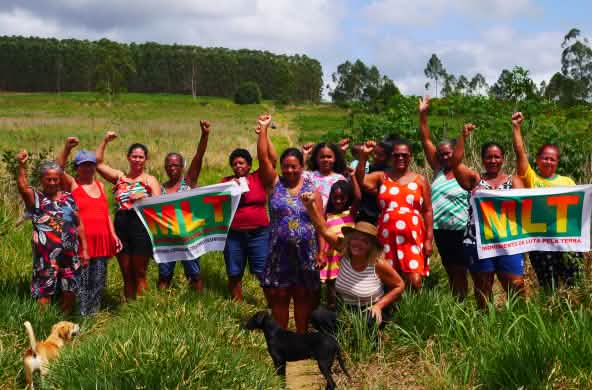
In the meantime, we have turned this barren land covered with eucalyptus monocultures into fertile agroecological and agroforestry systems. We grow food there such as cassava, bananas, and sweet potatoes,” the small farmers explained to us.

“We also raise seedlings of local tree species and plant them along the waterways and in other legally protected areas that were damaged by years of industrial exploitation and monocultures. We have already restored parts of the area, and other parts are on their way,” they told us. Soon, the Atlantic Rainforest native to Bahia will be thriving there again.
Although the small farmers have already signed an agreement with the state granting them usage rights, they still cannot use parts of the land even after almost two decades. That is why they asked us to give them a platform with our petition “We need fertile farmland, not industrial timber plantations”.
They are calling on the authorities to clear the land awarded to the MLT of unauthorized occupants and to implement the measures agreed with the state but still not carried out, such as the provision of drinking water, electricity and housing.
Extremely unequal land distribution
In Brazil, land ownership is distributed with extreme inequality. Less than one percent of corporate owners and large landowners control nearly 50 percent of the total land area. On the other hand, more than 47 percent of properties are farmed by smallholders, who have access to only about 2.3 percent of agricultural land. At the same time, more than 145,000 small farming families in Brazil are waiting for land to which they are entitled under the constitution. While the state’s progress in carrying out agrarian reform has been glacial, social movements continue to demand land and territory and resist injustice through occupations.
Green deserts

Altogether, the Veracel group claims 2,070 square kilometers of land in southern Bahia as its own. Well over half of it consists of eucalyptus plantations. Environmental groups and residents describe the eucalyptus monocultures as green deserts because they neither provide habitat for local plant and animal life nor livelihoods for the people living there. The fast-growing non-native trees destroy soil fertility, and the plantations do not retain water. On the contrary – they dry out streams and groundwater.
Mineral fertilizers and sprayed pesticides also poison the environment and kill flora and fauna. At least 17 different insecticides, fungicides, and herbicides are used by Veracel, including highly toxic chemicals banned in the EU such as sulfluramid, bifenthrin and imidacloprid.
Land grabbing and destruction for our paper consumption
Veracel’s activities in Brazil are closely tied to our paper consumption in Global North. Each year, Veracel produces 1.1 million tons of pulp from the wood of these trees, most of it for export. Eucalyptus fibers are used mainly to make printing and writing paper as well as hygiene products such as toilet paper, tissues and diapers. Our consumption of printer paper, tissues, diapers and toilet paper has devastating impacts in tropical countries.

In total, Brazil exports 15 million tons of eucalyptus pulp each year. EU countries alone import more than 10 million tons of cellulose from Brazil every year. Producing that volume requires around one million hectares of eucalyptus plantations.
Because of Europe’s economic interests, the public European Investment Bank (EIB) financed Veracel with two loans: in 2001, the EIB supported the establishment of a total of 26,200 hectares of eucalyptus plantations with US$30 million, and in 2003 it supported construction of Veracel’s pulp mill in Bahia with US$80 million. Ecological, social and legal criteria clearly did not play a decisive role in the bank’s financing decision.
Deception with a supposed sustainability label
Veracel’s industrial eucalyptus plantations are certified with the seal of Forest Stewardship Council GmbH (FSC), an organization based in Bonn, Germany – covering a total of 197,619 hectares of land. The label supposedly guarantees environmentally sound, socially responsible and economically viable forest management. Environmental and human rights organizations around the world – including Rainforest Rescue – reject the FSC label as deceptive window dressing and fraud. These industrial monocultures are not forests, nor are they environmentally friendly or socially just.
Further information:
- The Guardian, November 25, 2025. ‘Green desert’: the farmers winning a battle with Brazil’s wood-pulp giant: https://www.theguardian.com/global-development/2025/nov/05/brazil-green-desert-bahia-farmers-winning-battle-eucalyptus-wood-pulp-veracel-celulose
- Teia dos Povos, May 22, 2024. A Incessant Struggle by the Baixa Verde Settlement – MLT Against Eucalyptus Monoculture: https://teiadospovos.org/a-incessante-luta-do-assentamento-baixa-verde-mlt-contra-a-monocultura-do-eucalipto/
Teia dos Povos, accessed on December 3, 2025. A Incessante Luta do Assentamento Baixa Verde - MLT Contra a Monocultura do Eucalipto: https://teiadospovos.org/a-incessante-luta-do-assentamento-baixa-verde-mlt-contra-a-monocultura-do-eucalipto/
Veracel, accessed on December 3, 2025. OUR WAY - When we grow together we go much further: https://www.veracel.com.br/en/about-veracel/
Ação Discriminatória Judicial sob o n. 0000627-97.2010.8.05.0079.
IBGE, 2020. ATLAS DO ESPAÇO RURAL BRASILEIRO, Cap. 2: ESTRUTURA FUNDIÁRIA: https://www.ibge.gov.br/apps/atlasrural/pdfs/02_00_Texto.pdf and
Transparencia Internacional Brasil, 12-2021. GOVERNANÇA FUNDIÁRIA FRÁGIL, FRAUDE E CORRUPÇÃO: UM TERRENO FÉRTIL PARA A GRILAGEM DE TERRAS: https://comunidade.transparenciainternacional.org.br/grilagem-de-terras
Reporter Brasil, February 24, 2025. Brasil tem 145 mil famílias acampadas à espera de terra: https://reporterbrasil.org.br/2025/02/brasil-familias-acampadas-reforma-agraria/#:~:text=O%20BRASIL%20TEM%20PELO%20MENOS,de%20sem%2Dterra%20no%20país.
World Rainforest Movement (WRM), 2022. Brazil: The ‘Alert Against the Green Desert’ Network relights the flame of resistance: https://www.wrm.org.uy/bulletin-articles/brazil-the-alert-against-the-green-desert-network-relights-the-flame-of-resistance
Imaflora/FSC, 2021. Relatório de Auditoria de Certificação de Manejo/Gestão Florestal: https://fscglobal.my.salesforce-sites.com/servlet/servlet.FileDownload?file=00P4y00001l3V19EAEx
Folha de São Paulo, 2026. Vaivém: Exportação de celulose cresce, mas setor pode ter desequilíbrio: https://www1.folha.uol.com.br/colunas/vaivem/2026/02/exportacao-de-celulose-cresce-mas-setor-pode-ter-desequilibrio.shtml
European Investment Bank (EIB), accessed on December 3, 2025. Veracel pulp mill project, Brazil: https://www.eib.org/de/press/topical-briefs/all/veracel-pulp-mill-project-brazil
This page is available in the following languages:
Brazil: we need fertile farmland, not industrial timber plantations!
Every sheet of paper has a cost. In Brazil, that means forests cleared, communities displaced, and small farmers pushed off their land.
Land conflicts
Farmland is in high demand. Corporations are acquiring vast tracts of land in Africa and South America to produce food and biofuels for export.