
Liberia: Protect forest defenders, reject false climate solutions!
Liberia’s rainforests are among West Africa’s last great forest strongholds. They are still standing in large part because forest communities have defended them for generations. Now a proposed Carbon Market Policy threatens those communities’ rights and puts the future of the forests at risk. It must be stopped.
News and updatesTo: President Joseph Nyuma Boakai
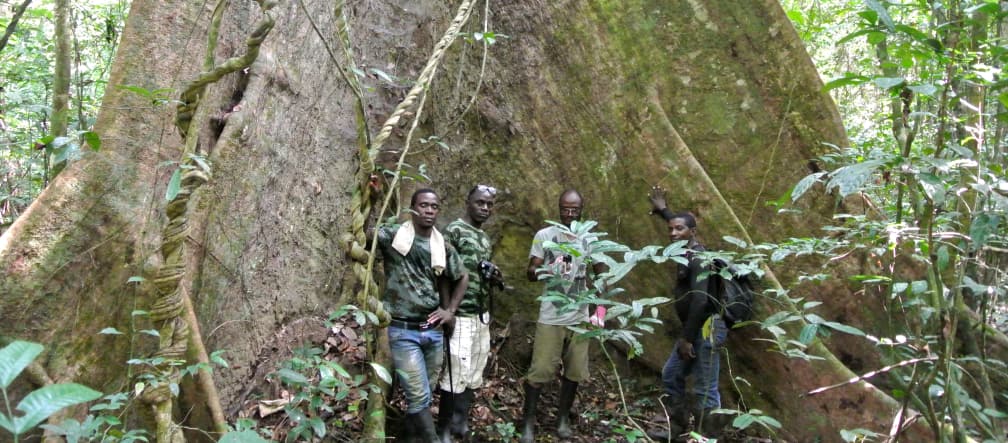
“Do not endorse the draft Carbon Market Policy – only developers would profit, while forest communities would pay the price and the climate would gain nothing.”Western chimpanzees are one of Liberia’s flagship species, and their survival depends on protecting the rainforest. Forest communities are central to that effort: the people who live in and from the forest have safeguarded it for generations. Liberian law recognizes that role: 70 percent of the country’s forests are legally under community stewardship.
Now those rights are under threat from a proposed Carbon Market Policy. Liberia’s government wants to profit from selling carbon credits linked to these forests. Companies such as airlines buy these credits to claim climate action while continuing to pollute.
Environmental groups warn that the policy process has been “significantly truncated,” especially when it comes to meaningful participation by forest communities and civil society.
The carbon market is evading the truth. It puts forest-dependent people at the margin and takes away their dignity.”
–James Otto, Sustainable Development Institute (SDI).
“The government needs to be honestly sincere, openly engage with forest communities and place community priorities at the top of the carbon policy development,” Otto continued.
More than 25 organizations in Liberia’s NGO Coalition, including Rainforest Rescue’s partner SDI, have urged President Joseph Nyuma Boakai not to sign the policy.
In a letter, the coalition said it is “not a routine administrative instrument” but a framework that will shape how Liberia’s forests, lands and carbon resources are controlled and monetized for years to come.
Around the world, critics call carbon credits a false solution to the climate crisis because they let companies keep polluting. In Liberia, the immediate danger is clear: communities that have protected the forest for generations could be pushed aside while the government, developers and traders reap the rewards.
Stand with Liberian environmentalists: urge President Boakai not to sign the draft Carbon Market Policy.
For further information on carbon certificates and carbon credits, and our criticism of both, please visit our background page on the climate market.
In a nutshell: after 15 years of experience and despite billions in funding, offset models, including carbon certificates, have done little to protect the climate and forests and are often little more than greenwashing. Worse, they have delayed real action to cut emissions, harming the climate in the process. There is also a risk that offset projects can trigger land conflicts and land grabbing and violate the rights of Indigenous peoples and local communities.
NGO letter in full
His Excellency Joseph Nyuma Boakai, Sr.
President of the Republic of Liberia
Executive Mansion
Capitol Hill, Monrovia
April 30, 2026
Your Excellency:
On behalf of the NGO Coalition of Liberia, a network of over 25 Civil Society Organizations (CSO) working in the Forest Sector, extend sincere compliments and appreciation for Your Excellency’s leadership and continued commitment to advancing Liberia’s sustainable development agenda, particularly in the areas of climate action and natural resource governance.
We write, with utmost respect, to urgently appeal that Your Excellency defer the endorsement and signing of Liberia’s Draft Carbon Market Policy until a genuine, inclusive, and credible national validation process has been conducted.
While recognizing the efforts made by the Environmental Protection Agency, the Carbon Market Authority, and the Forestry Development Authority in advancing this policy, we express growing concern that the process leading to its “final validation” has been significantly truncated especially with respect to the meaningful participation of key stakeholders. In particular, we note that the validation process at both the technical and national levels did not involve the full and meaningful participation of key stakeholders. Forest-dependent communities, civil society organizations, and other critical actors – whose engagement is essential to the legitimacy, implementation, and long-term success of this policy – have not been adequately consulted in a manner that meets the standards of inclusivity, transparency, and informed consent. But most importantly, there remain fundamental disagreements on a number of critical issues that require further discussion.
Your Excellency, Liberia’s carbon market policy is not a routine administrative instrument. It is a foundational framework that will determine how Liberia’s forests, lands, and carbon assets are governed, monetized, and potentially committed under long-term agreements. Importantly, this policy framework will also serve as the basis for developing future legislation on carbon marketing and a broader national climate law. As such, any gaps, weaknesses, or exclusions at this stage risk being carried forward and institutionalized within binding legal frameworks that will shape the sector for generations.
The implications for national sovereignty. community land rights. benefit-sharing, and intergenerational equity are therefore profound.
We respectfully note that endorsing such a policy without a robust national validation risks:
- Undermining the legitimacy and public trust in national policy, as well as damaging the international reputation of Liberia, given that the policy potentially undermines Liberia’s ability to maintain its bilateral investment treaties and fulfil its Nationally Determined Contributions under the Paris Agreement;
- Exposing communities to arrangements that they neither fully understand nor have consented to;
- Creating conditions for inequitable or unfavourable carbon agreements that may be difficult to renegotiate;
- Embedding structural gaps into future legislation on carbon markets and climate governance.
It is therefore both prudent and in the national interest to ensure that this policy is grounded in a process that reflects true national consensus - not one shaped by compressed timelines or external pressures.
In this regard, we respectfully urge that:
- The endorsement and signing of the Draft Carbon Market Policy be deferred;
- A comprehensive national validation process be convened, ensuring the full and effective participation of communities, civil society. and other stakeholders across affected regions;
- Adequate time and space be provided for technical review, public dialogue, and incorporation of stakeholder inputs before final approval.
We remain confident in Your Excellency’s commitment to protecting the interests of the Liberian people and ensuring that the country’s natural resources are governed in a manner that is just, transparent, and beneficial to all.
Please accept, Your Excellency, the assurances of our highest consideration.
To: President Joseph Nyuma Boakai
Your Excellency President Joseph Nyuma Boakai,
Liberia is globally recognized for its outstanding forest protection. Western chimpanzees are one of its flagship species, and the survival of their habitat is largely thanks to local communities who protect the forests they depend on.
We are deeply concerned that the proposed Carbon Market Policy hurts these communities and alienates them from environmental protection. While they have safeguarded Liberia’s forests for generations, the policy risks rewarding the government, developers and traders far more than the people who have long protected these lands.
We note that endorsing the draft Caron Market Poilcy without a robust national validation risks:
- undermining the legitimacy and public trust in national policy, as well as damaging the international reputation of Liberia, given that the policy potentially undermines Liberia's ability to maintain its bilateral investment treaties and fulfill its Nationally Determined Contributions under the Paris Agreement;
- exposing communities to arrangements that they neither fully understand nor have consented to – thus a recipe for future community-investor conflicts;
- creating conditions for inequitable or unfavorable carbon agreements that may be difficult to renegotiate;
- embedding structural gaps into future legislation on carbon markets and climate governance.
We respectfully urge that:
- the endorsement and signing of the draft Carbon Market Policy be deferred;
- a comprehensive national validation process be convened, ensuring the full and effective participation of communities, civil society, and other stakeholders at the grassroots level across affected regions;
- adequate time and space be provided for technical review, public dialogue, and incorporation of stakeholder inputs before final approval.
Yours faithfully,
How the climate and rainforests are linked
Rainforests are complex ecosystems in which a vast number of animal, plant and fungi species are tightly interdependent. They play a major role in the local and global climate: In a process called photosynthesis, plants absorb the greenhouse gas carbon dioxide (CO2) from the air. With the help of water and sunlight, they form sugar and from it other plant building blocks. In doing so, plants sequester carbon in stems, leaves and roots while releasing oxygen into the atmosphere.
According to studies, rainforests sequester 250 billion tons of CO2, much of it in peat forests. Globally, this is equal to 90 times the man-made greenhouse gas emissions per year.
Rainforests themselves produce a large part of the high year-round rainfall they receive. Evapotranspiration, i.e. the moisture that the plants release through their leaves, is an important aspect here. The forests are hot and humid, but the clouds reflect much of the sunlight back into space – thus cooling the atmosphere. Without this effect, the areas would be even warmer.
As carbon sinks and rainmakers, intact forests play an important role in regulating the climate and are crucial to the fight against catastrophic climate change.
The problem: catastrophic climate change and forest destruction
Rainforests are increasingly unable to act as climate stabilizers: When they are destroyed for plantations, grazing area or mining projects, vast amounts of greenhouse gases are released. For example, forest fires in Indonesia accounted for one-third of total global emissions in 1997. The loss of peat forests is particularly devastating.
According to a study published by Nature, rainforests could tip from carbon sinks to carbon emitters solely due to changing climatic and growth conditions from 2035 onward – thus accelerating catastrophic climate change.
Because of the intricate interdependencies of the rainforest ecosystem, the entire web can suffer if it is damaged in one place. Take the water cycle, for example. If drier periods occur as a result of global climate change – and this is already being observed – the cycle may break down. This can lead to evergreen, lush rainforests becoming grasslands with far lower biodiversity. The local climate would become drier and hotter.
The 18 tipping points in the climate system are particularly ominous: If, for example, climate change in the Amazon region reaches a certain point, the process and the loss of the rainforest in its current form will become unstoppable.
One thing is clear: catastrophic climate change is man-made. 98 percent of the scientists who study climate issues agree. Because the climate is a highly complex system, researchers are constantly discovering new relationships, interpreting data in different ways and revising forecasts. This is completely normal in science. However, the findings of climatologists are becoming increasingly alarming.
The solution: rainforest protection is climate protection
Rainforests must be preserved because they are indispensable as carbon sinks and their further destruction would worsen the impact of catastrophic climate change. Climate protection is therefore rainforest protection and vice versa.
- We need to preserve forests and nature and heal damage. Forests are more than just carbon sinks – they are diverse ecosystems and home to millions of people.
- We need to protect the climate while preserving biodiversity. Catastrophic climate change and extinction are two existential crises that we must tackle together.
- We need to secure and strengthen the rights of indigenous peoples, who are often the forest's best stewards: We call it the rainforest – they call it home.
- We need to fundamentally change our way of life and how we do business: This will mean reducing our consumption of energy, food and raw materials instead of maintaining it by turning to “green products”. We must stop burning fossil fuels.
- We need to reform flawed climate policy: We must end the misguided use of biofuels, especially if they are based on palm oil, soy or sugar cane, and stop burning trees in power plants.
- We reject offset programs as a modern “indulgence trade” in which companies finance environmental protection measures in return for being allowed to pollute. We also reject supposedly more climate-friendly “bridge technologies” like replacing coal with natural gas.
- In the wake of the Covid pandemic, we need to rebuild the economy and society in an environmentally sound way. There must be no economic “stimulus programs” based on old formulas.

The company Socfin is known for its plantations in Africa and Asia – and for its legal attacks on NGOs. In Belgium, three such organizations are now pushing back in an unusual way: They are suing the plaintiff.
Boycotts of tropical timber and resistance to the palm oil boom, GPS data and Indigenous rights in defense of forests – a great deal has happened in the 40 years since Rainforest Rescue was founded. We dug through our archive for photographs that mark milestones in our organization’s history.
Based on Liberia’s Land Rights Act