Completed campaign
Brazil: Keep Deutsche Bahn out of Amazonia!
Success: Together with our Brazilian partner organizations, we persuaded Deutsche Bahn not to join the GPM project and stopped funding through the European Commission’s Global Gateway initiative.
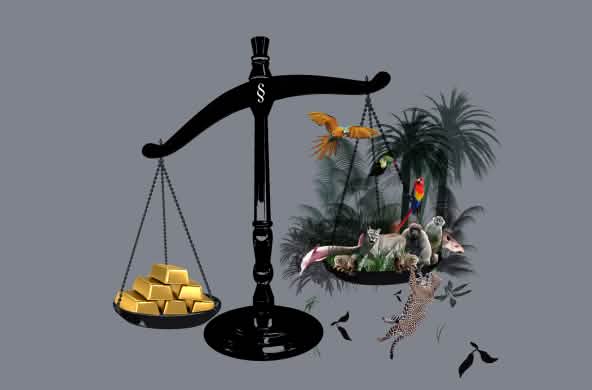
A destructive rail and port project is taking shape in the Amazon region of Brazil. Germany’s national railway, Deutsche Bahn (DB), is involved. If realized, millions of tons of soy and iron ore will be exported to China, Europe and the USA. The people of Brazil, the rainforest and the coastal mangroves will suffer.
News and updatesTo: Chairman of the Deutsche Bahn Management Board and CEO, Dr. Richard Lutz; Deutsche Bahn and its subsidiaries
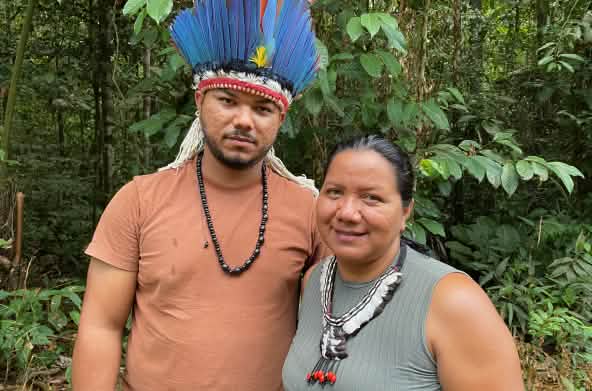
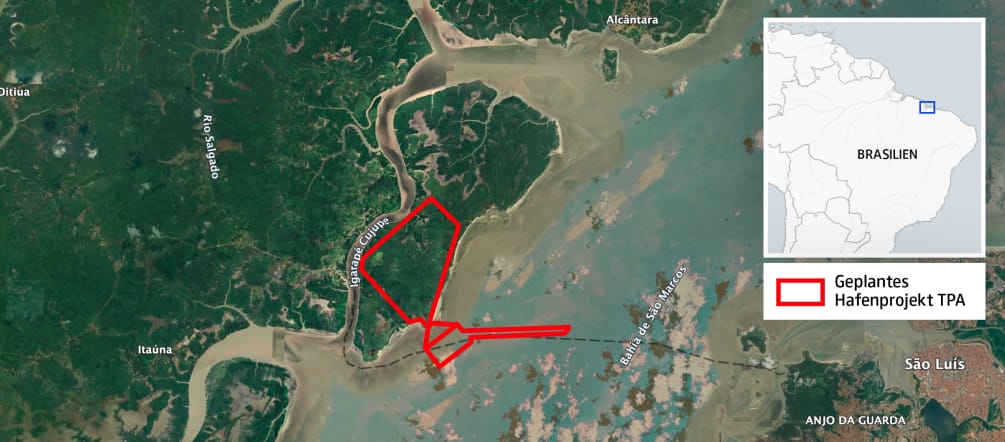
“Deutsche Bahn must not participate in the GPM rail and port project in the Amazon rainforest of Brazil.”GPM, a project being developed by Portuguese businessmen, wants to clear and develop large parts of the island of Cajual in northeastern Brazil for the Alcântara Port Terminal (TPA), a private industrial and port complex – in the very area that is home to traditional communities of the Quilombola, the descendants of formerly enslaved people from Africa.
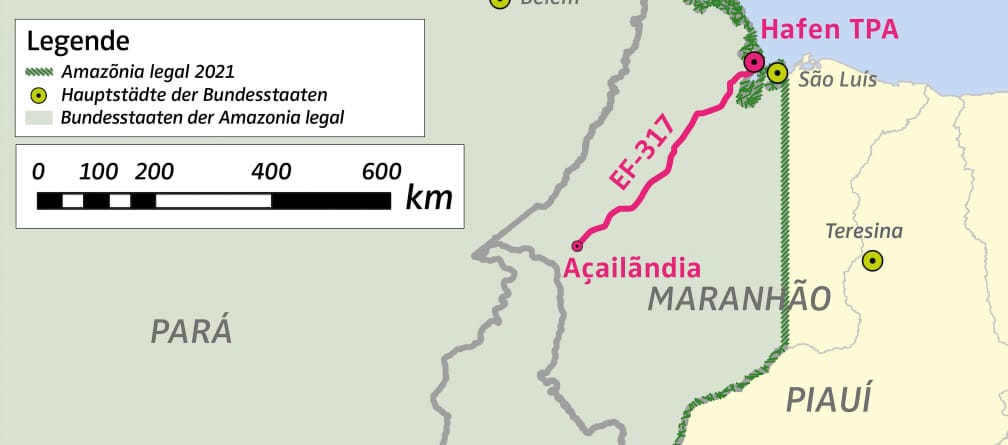
Along with the port, a 520-kilometer private freight railway, the EF-317, would reach deep into the Amazon region. It would cut through numerous traditional communities, and six Indigenous territories are located nearby.
Germany’s national railway, Deutsche Bahn (DB), is involved in the project. Its subsidiary, DB E.C.O. Group, has signed a memorandum of understanding with GPM to jointly develop and operate the railway.
For eight years, the project has been taking shape without informing the public or respecting the rights of Indigenous peoples and Quilombolas to consultation and free, prior and informed consent, as required by UN Convention ILO 169, signed by Brazil and Germany. No studies have been made of the project’s impact on the population and the environment.
The project would be located in two protected areas on the Atlantic coast, which feature the largest contiguous and intact mangrove belt in the world. The island of Cajual is home to a breeding colony of 2,500 scarlet ibises and wintering area for migratory birds from North America.
In addition, the railway would run through the middle of the “Belém Endemic Area”, the region of the Amazon basin most threatened by deforestation.
The project would leave the region wide open for explotation and the export of commodities like soy, iron ore, copper, fracked gas and hydrogen.
Please sign our petition and tell Deutsche Bahn to withdraw from the Amazon project immediately.
Start of petition: 01/08/2024
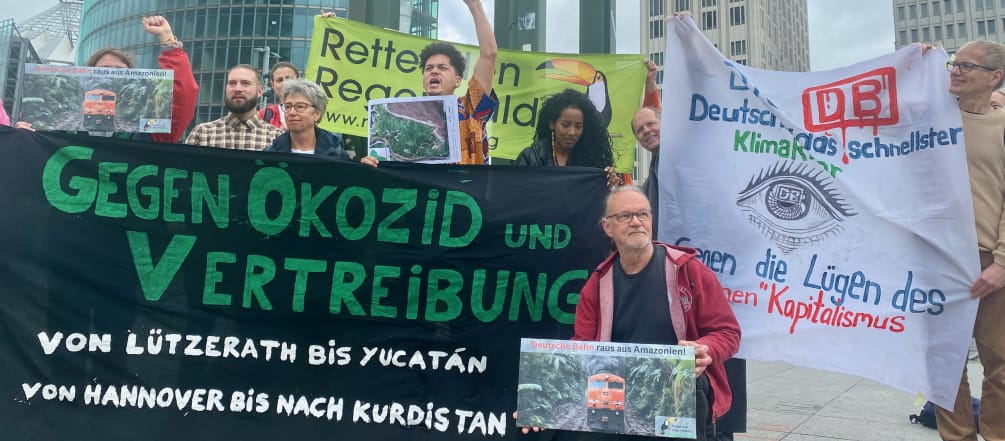
On May 31, 2024, Rainforest Rescue, together with our Brazilian partner organization Justiça nos Trilhos, the Chile-Latin America Research and Documentation Center (FDCL), Kooperation Brasilien (Kobra) and Misereor, held a demonstration in front of the DB headquarters at Potsdamer Platz in Berlin and filed a complaint against the involvement of the DB subsidiary DB E.C.O. Group in the GPM project.
According to the participating organizations, GPM’s actions violate the International Labour Organization’s (ILO) Convention No. 169 on Indigenous Peoples, which has been ratified by the German government, as well as the German Supply Chain Act, which imposes special due diligence obligations on German companies. The GPM project also threatens the Amazon rainforest, the protection and conservation of which is an important goal of German development, environmental and climate policies. We therefore call on DB to withdraw from the project immediately.
DB’s response
DB’s complaints office has initiated the review process, but the outcome is uncertain. DB’s Chairman of the Management Board and CEO, Dr. Richard Lutz, wrote to us that respect for internationally recognized human rights and fundamental freedoms is an important principle for DB, that the company takes our concerns very seriously, and that “several additional requirements must be met before DB will consider participating in the project.”
Meanwhile, managers from DB’s subsidiaries, together with GPM’s project operators, are attending meetings with Brazilian ministers, government officials and members of parliament to move the project forward. GPM is also using the DB name prominently to give the GPM project an air of seriousness and competence.
In a GPM corporate video, the Amazon rainforest has been shifted to the west to give the impression that the planned Alcântara port terminal and the route for the EF-317 freight railway are outside the Amazon region. The video also make the astonishing claim that Brazilian agricultural production can increase by 180% in the next ten years “without cutting any trees”.
But the video and the information provided by the project’s promoters are misleading: The Amazon region is officially defined in Brazil as the “Legal Amazon” (Amazônia legal). Both the port and the entire rail line are clearly within the legal Amazon, as our map with data from the Brazilian Institute of Geography and Statistics (IBGE) shows. According to a recent study, agriculture, especially soy, is the main driver of deforestation in Brazil: Government figures state that 9,064 square kilometers – an area 3.5 times the size of Greater London or more than 11 times the size of New York City – were cleared in 2023 alone.
To: Chairman of the Deutsche Bahn Management Board and CEO, Dr. Richard Lutz; Deutsche Bahn and its subsidiaries
Dear Dr. Lutz, Ladies and Gentlemen,
Environmental, human rights, Indigenous and Quilombola organizations from the Brazilian state of Maranhão are warning of the negative impacts of the planned construction of a 520-kilometer freight railway in the Amazon region, as well as the planned construction of an industrial zone and export port on the Atlantic coast.
The organizations oppose the Grão-Pará Maranhão (GPM) project because its planning does not respect fundamental principles such as the right of Indigenous peoples, Quilombolas and traditional communities to consultation and free, prior and informed consent. This is exactly what the UN Convention ILO 169, signed by Brazil and Germany, requires. Furthermore, the impact of the project on the population and the environment has not been studied.
Deutsche Bahn’s subsidiary, DB E.C.O. Group, has signed a memorandum of understanding with GPM for the joint project development and subsequent operation of the railway. Organizations in Brazil and Germany are calling on Deutsche Bahn and its subsidiary to drop the project.
If realized, the rail and port project will transport many millions of tons of agricultural and mining commodities, such as soy and iron ore, from the Amazon rainforest and the Cerrado savannah every year. The impact on traditional communities and the rainforest would be devastating.
Yours faithfully,
August 6, 2024
EU delegation in Brazil: Talks with GPM and Quilombola community
The operators of GPM are currently said to be seeking investors and loans for the rail and port project. In response to a written inquiry from Rainforest Rescue, the European Union (EU) ambassador to Brazil, German diplomat Marian Schuegraf, confirmed that her delegation has spoken with the backers of the Grão-Pará Maranhão (GPM) project.
She also wrote to us that “she has made it a priority to meet with the Quilombola community on Cajual, which is affected by the project, in order to receive first-hand information directly from their side.”
In April 2024, the EU ambassador led a delegation of 19 EU member state ambassadors to Maranhão1. The itinerary included visits such as the existing Itaqui export port, located across the Bay of São Marcos directly opposite the island of Cajual, just outside the city of São Luís. The delegation also visited the district of Alcântara, which encompasses the island where the planned port site would be.
Press articles in Brazil2 have suggested that GPM may receive funding through the European Commission’s Global Gateway initiative. The fund aims to provide 300 billion euros in financing for strategic projects worldwide through 2027. The Global Gateway country page for Brazil3 and the Global Gateway country sheet dated April 20244 highlight four “flagship initiatives,” including “Multimodal transport and mobility: building port and rail infrastructure to close existing infrastructure gaps and connect Brazil with Europe.”
1 Post on the X account of the EU Embassy in Brazil, April 4, 2024. Primeiro dia da visita oficial ao Maranhão dos embaixadores dos estados-membros da UE: https://x.com/UEnoBrasilEmb/status/1775856433113784322
2 O Informante, March 24, 2024. José Reinaldo destaca importância histórica da possibilidade do primeiro financiamento apoiado pela União Europeia: https://portaloinformante.com.br/noticias/2024/03/jose-reinaldo-destaca-importancia-historica-da-possibilidade-do-primeiro-financiamento-apoiado-pela-uniao-europeia/
3 European Commission, 2023. https://international-partnerships.ec.europa.eu/countries/brazil_en

For the past year, Rainforest Rescue and partner organizations have worked hard to make Deutsche Bahn (DB) aware of the potentially disastrous consequences of a planned rail-and-port project in Brazil – with success: DB has now informed us that it no longer intends to participate in the GPM infrastructure project in the Amazon rainforest.
Together with our partner organizations from Brazil, we were in Brussels at the end of November to stop EU funding for a planned rail and port project in the Amazon rainforest in Brazil – with success! Our letter and visit were key to the European Commission’s decision not to fund the project.
Germany’s national railway company Deutsche Bahn (DB) carefully cultivates a public image of environmental and social responsibility. However, its possible involvement in a destructive private infrastructure project in Brazil’s Amazon rainforest suggests a stark contrast – and it appears DB may be trying to obscure the truth about its participation.
Grão-Pará Maranhão (GPM): https://graoparamaranhao.com/en/
Directly affected are two Quilombo communities, Alcântara and Tanque de Valenca, as well as 16 agrarian reform settlements and 22 communities:
Alcântara; 2. Bequimão; 3. Peri Mirim; 4. Palmeirândia; 5. São Bento; 6. São Vicente Ferrer; 7. Olinda Nova do Maranhão; 8. Matinha; 9. Viana; 10. Pedro do Rosário; 11. Penalva; 12. Monção; 13. Zé Doca; 14. Governador Newton Bello; 15. Alto Alegre do Pindaré; 16. Santa Luzia; 17. Bom Jardim; 18. Buriticupu; 19. Bom Jesus das Selvas; 20. Amarante do Maranhão; 21. São Francisco do Brejão; 22. Açailândia
The officially recognized and demarcated Indigenous territories of Alto Turiacu, Akroá Gamela, Arariboia, Awa, Caru and Pindaré
DB E.C.O. Group, February 3, 2023. Brazil’s multimodal logistics solution for sustainable supply: https://web.archive.org/web/20230320181123/https://db-eco.com/en/brazils-multimodal-logistics-solution-for-sustainable-supply/
Área de Proteção Ambiental (APA) Reentrâncias Maranhenses: https://uc.socioambiental.org/en/arp/782 and
APA Baixada Maranhense: https://uc.socioambiental.org/en/arp/785
Both are also protected under the UN’s international RAMSAR Convention as wetlands of international importance: https://rsis.ramsar.org/ris/640 and https://rsis.ramsar.org/ris/1020
Instituto Chico Méndes, 2018. The Brazilian Mangrove Atlas. Executive Summary: http://www.mangrovealliance.org/wp-content/uploads/2018/05/Brazil-Mangroves-Atlas.pdf and Instituto Chico Méndes, 2018.
ATLAS DOS MANGUEZAIS DO BRASIL: https://ava.icmbio.gov.br/pluginfile.php/4592/mod_data/content/14085/atlas%20dos_manguezais_do_brasil.pdf
Rodrigues, AA 1995. Ocorrênciada reprodução de Eudocimus ruber na ilha do Cajual, Maranhão, Brasil. Download article as a PDF: http://www.revbrasilornitol.com.br/BJO/article/download/0314/pdf_63
Migratory birds include the Hudsonian Godwit (Limosa haemastica) and the Whimbrel (Numenius phaeopus)
M. Goeldi, 2015. Cenários para a Amazônia: Área de Endemismo Belém. Sumário executivo: https://www.researchgate.net/profile/Marcia-Barros-2/publication/323454047_Cenarios_para_Amazonia_Area_de_Endemismo_Xingu_Sumario_Executivo/links/5a96bc51a6fdccecff0a34bf/Cenarios-para-Amazonia-Area-de-Endemismo-Xingu-Sumario-Executivo.pdf
https://www.regenwald.org/files/de/240531Beschwerde%20Deutsche%20Bahn%20AG.pdf
European Parliament, 2021. Menschenrechte – Bundestag ratifiziert Konvention zu Rechten indigener Völker: https://www.bundestag.de/dokumente/textarchiv/2021/kw15-de-rechte-indigener-voelker-830908
German federal government, 2024. Verantwortung in globalen Lieferketten – Mensch und Umwelt besser geschützt: https://www.bundesregierung.de/breg-de/aktuelles/lieferkettengesetz-1872010
BMZ, 2023. NEUSTART FÜR DEN AMAZONIENFONDS – Entwicklungsministerium gibt 35 Millionen Euro für Regenwaldschutz in Brasilien frei: https://www.bmz.de/de/aktuelles/aktuelle-meldungen/deutschland-gibt-35-millionen-euro-fuer-den-amazonienfonds-frei-135998
Reply from Dr. Richard Lutz, Chairman of the DB Management Board and CEO, dated June 26, 2024: Reply-letter-Dr-Lutz-DB-Board-Chairman-27-6-24.pdf
Grão-Para Maranhao, 2023. GPM PRESENTS A VENTURE IN PARTNERSHIP WITH DB AND SYSFER: https://graoparamaranhao.com/en/news/gpm-presents-a-venture-in-partnership-with-db-and-sysfer/ and CONSTRUCTIVE MEETING WITH THE MINISTER OF PORTS AND AIRPORTS: https://graoparamaranhao.com/en/news/meeting-minister-of-ports-airports/
GPM corporate video in English: https://graoparamaranhao.com/en/news/tpa-ef-317-institutional-video-is-very-well-received-by-the-market/
Carreiora, I. et.al., 2024. The deforestation effects of trade and agricultural productivity in Brazil: https://www.sciencedirect.com/science/article/abs/pii/S0304387823001736
Ministério da Ciência, Tecnologia e Inovação, 2024. Desmatamento na Amazonia cai 21.8% em 2023: https://www.gov.br/mcti/pt-br/acompanhe-o-mcti/noticias/2024/05/desmatamento-na-amazonia-cai-21-8 -em-2023