Indonesia pits the military against Papua’s forests and Indigenous peoples
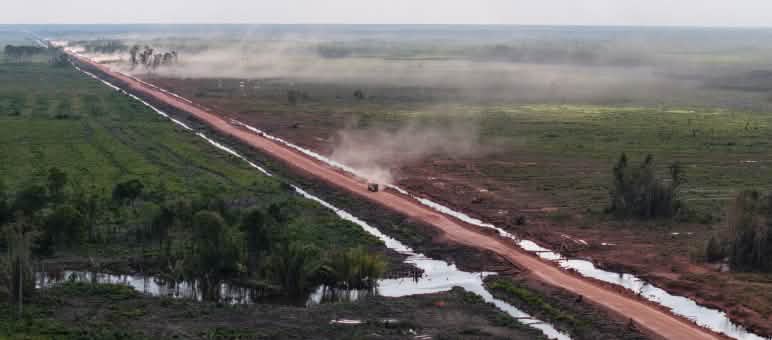
Indigenous Marind people are resisting construction of a 135 km-long road for PSN Merauke in Papua. The project would clear 2.7 million hectares of rainforest and other ecosystems for industrial sugarcane, rice and oil palm plantations. The minister of defense describes the road as “infrastructure against the global food crisis” and its construction as a “non-war military operation.”
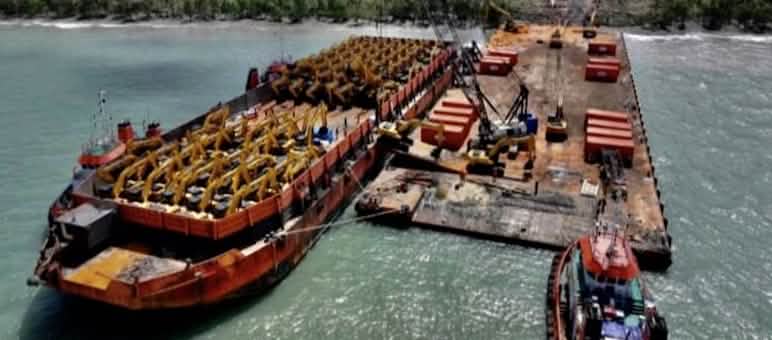
Since mid-2024, barges from the Jhonlin Group have delivered hundreds of excavators to Merauke in southern Papua. They were soon followed by cruise ships carrying Indonesian armed forces (TNI). The soldiers are securing the largest state-led deforestation operation in Indonesia’s last truly vast rainforest, home to tree kangaroos and birds-of-paradise.
The project is establishing plantations across 2.7 million hectares – an area almost twice the size of Northern Ireland – for sugarcane, rice and oil palms. The aim is to produce palm oil and ethanol for Indonesia’s ambitious biofuel program. Vast rice fields are also planned, to be mechanized and farmed by soldiers.
This Merauke National Strategic Project (PSN Merauke) includes sugar and biodiesel factories, as well as infrastructure such as a port and roads.
In September 2024, deforestation began with military involvement, alongside construction of a 135 km-long road linking the plantation areas to a port. By July 2026, 50 km had already been built.
In September 2025, one year after construction began, the regent (bupati) issued the required environmental permit.
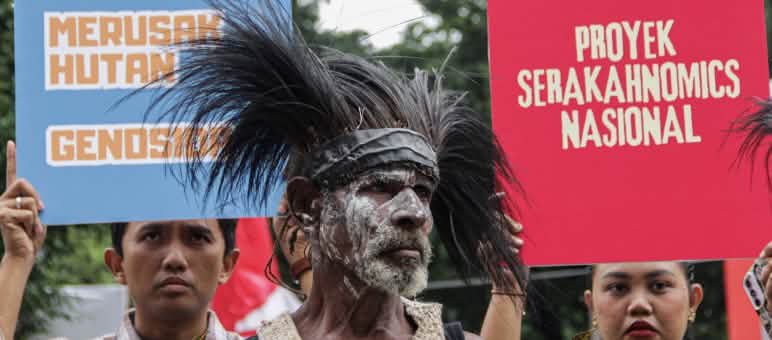
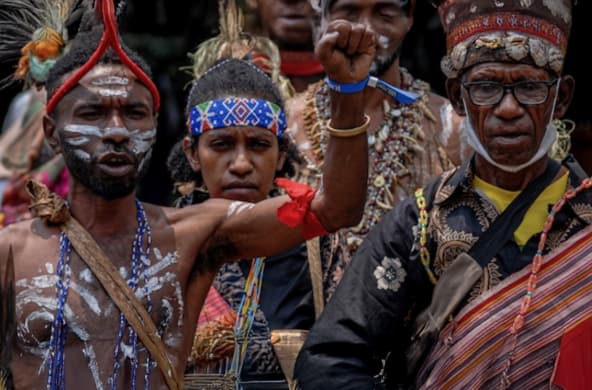
Resistance and protest against this reckless project are strong in Merauke, Indonesia’s capital Jakarta and around the world. Affected Indigenous Marind and Yei communities have set up blockades to stop deforestation and construction work, marking their land with large red crosses. Their protests have also reached Jakarta.
80,646 people have signed our petition “Stop the destruction of Papua’s Marind forest” calling on the president, ministers and the UN Human Rights Council to end the “Merauke National Strategic Project,” stop the deforestation and respect Indigenous Papuans.
More than 14 million people have watched Pig Feast – a film about deforestation and resistance in Papua.
Indigenous people are now challenging the environmental permit for construction of the 135 km-long road in court.
Status of the case
- March 5, 2026: Five Marind representatives filed a lawsuit with the Administrative Court in Jayapura against the environmental permit for construction of the road.
- June 2026: The case entered the evidentiary phase. The plaintiffs requested that construction work be suspended until the court rules.
- July 2026: Numerous witnesses were heard, including affected community members, the regent of Merauke and the minister of defense.
Witness testimony
The Marind state that deforestation and road construction took place without adequate consultation and without their consent. Instead, they are being intimidated by the military.
The plaintiffs argue that construction work was carried out for one year without the required permit and that their rights as an Indigenous community are being violated. They call on the court to stop the project.
The regent of Merauke and the minister of defense, however, deny that a road is being built without an environmental permit. They describe it as necessary infrastructure to counter the “threat of a global food crisis”.
The minister described the military’s involvement as a “non-war military operation”.
The court has repeatedly instructed the regent of Merauke and the minister of defense to halt construction work while the case is ongoing. Despite those instructions, work is continuing unabated.
Solidaritas Merauke
Solidaritas Merauke, an alliance of legal aid, human rights and environmental groups, says the witness testimony establishes three clear points: first, road construction was illegal for one year because no environmental permit was in place; second, the environmental documents now in place have no legal force and serve only to legitimize the project after the fact; and third, the rights of Indigenous people are being violated.
According to the lawyers of Solidaritas Merauke, the witness testimony gives the court sufficient grounds to revoke the environmental permit for the road’s construction.
In Indonesia, as in most democratic states, domestic security is generally the responsibility of the police. But since Prabowo Subianto became president, the military’s role has expanded dramatically. Papua is a stark example: five new battalions have been deployed there.
In the PSN Merauke sugar and bioethanol project, the military is not merely securing deforestation and road construction. Soldiers are clearing land and planting crops themselves, while the heavy troop presence creates an atmosphere of fear.
In democratic states, military operations other than war are strictly regulated by constitutions and legislative bodies. They are generally limited to disaster relief and domestic emergencies.
Subscribe to our newsletter.
Stay in the loop on rainforest conservation issues with our free newsletter!
This page is available in the following languages:
Indonesia: Stop the destruction of Papua’s Marind forest!
Indonesia is implementing a sugar and ethanol program in southern Papua under military protection. Two million hectares of rainforest and Indigenous land are at risk.

Biofuel
The use of bioethanol and biodiesel in motor vehicles is a misguided attempt to save the climate. The ugly reality is that "green" fuels are destroying rainforests, accelerating climate change and condemning millions to poverty and hunger.