Corporations and banks seal the fate of Tapanuli orangutans
Indonesia: In the forest of Sumatra’s Tapanuli orangutans, construction of a hydropower plant and gold mining continue even in the wake of Cyclone Senyar. For investors and the governments of China and Indonesia, “green energy” and critical minerals seem to carry more weight than ecosystems and endangered species.
Tapanuli orangutans after the cyclone
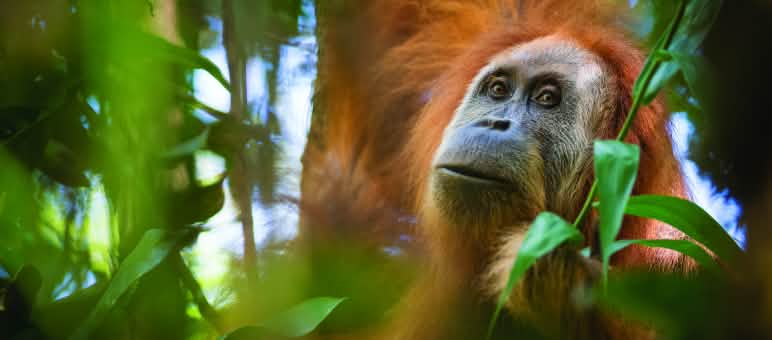
Cyclone Senyar devastated Sumatra in late November 2025 and claimed more than a thousand lives. Its ecological impact on the Batang Toru Forest in the Tapanuli region of North Sumatra has been particularly devastating. Tapanuli orangutans live only here. With fewer than 800 individuals, they are the world’s rarest great ape species.
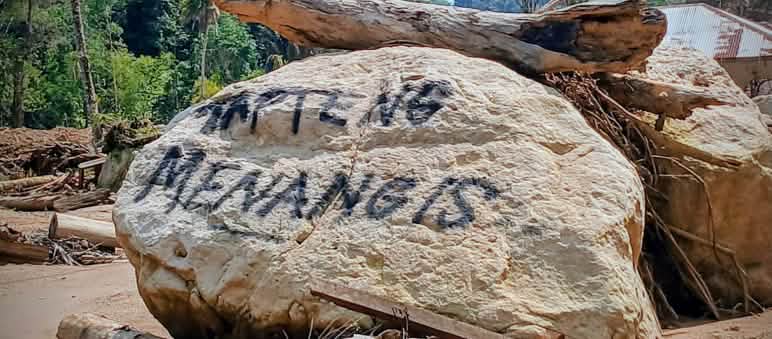
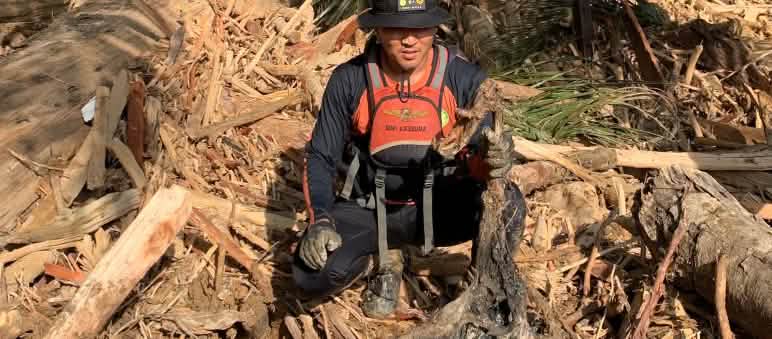
Torrential rains combined with deforestation in this highly sensitive ecosystem to cause a disaster of historic proportions. The flooding triggered more than 50,000 landslides. Mud and debris flows raced down steep slopes, exposing bare ground for miles.
Satellite analyses showed that around 8,300 hectares of intact rainforest were completely destroyed in the western block of the Batang Toru Forest alone. This loss in just six days exceeds all deforestation between 2000 and 2023 caused by large-scale industrial projects, illegal logging and agriculture.
Parts of the forest canopy were destroyed. The fragmentation of the forest makes it harder for Tapanuli orangutans to find food and pushes them closer to extinction. Scientists estimate that 58 animals died – 7 percent of the entire population.
“This level of loss is substantial for a species with such a small total population,” says primatologist Erik Meijaard.
Sanctions on paper only
When it could no longer be denied that forest destruction had worsened the storm’s impact, the Indonesian government acted: In January 2026, it revoked the permits of companies responsible for much of the deforestation. They include the Batang Toru hydropower plant, the Martabe gold mine south of the forest and pulp producer Toba Pulp Lestari, with its extensive eucalyptus plantations.
The companies suffered economic losses, but the damage after the cyclone – destroyed infrastructure, crop failures and blocked supply chains – is far higher, at more than 100 million euros. From the outset, we suspected that this step would not last. Political power and oligarchic interests are too tightly intertwined.
“Experience so far shows that without public pressure, revoking permits remains little more than symbolic politics,” warned Rianda Purba, director of our partner organization WALHI North Sumatra.
Indeed, in mid-May 2026, PT Agincourt Resources was permitted to resume operations at the Martabe mine. The government evidently plans to transfer the gold mine to the new state-owned energy and natural resources company Perminas in the long term.
The fate of pulp company Toba Pulp Lestari remains undecided. Since early 2026, Indonesia’s Ministry of Environment has been pursuing legal action against the company. The environmental organization WALHI has joined the proceedings as a third-party plaintiff.
As early as March, construction of the Batang Toru hydropower plant was allowed to resume, albeit subject to stricter conditions. The operator, PT North Sumatra Hydro Energy (NSHE), is legally obliged to build canopy bridges across roads and clearings.
Biologists criticize these corridors, arguing that orangutans are shy creatures of habit. It often takes years before they accept such artificial structures. Until construction ends in October 2026, the noise will frighten off the animals. But the core problem remains the fragmentation of the forest by roads and power lines.
Construction is now pushing ahead at full speed, with the aim of connecting the power plant to the grid in October 2026. The acceleration follows a court settlement: NSHE agreed to pay the state a fine of around US$12.7 million to cover the hydrological damage. Compared with the ecological damage at stake, that sum is laughable.
China seals the fate of the Tapanuli orangutans
The Bank of China initially financed the power plant. Following widespread protests and high-profile petitions, including our petition Stop bulldozing the Tapanuli orangutan, which drew more than 400,000 signatures, the bank withdrew from the project’s financing. But this only delayed construction.
This was followed by a restructuring of the project’s financing. The project is now firmly in the hands of the Chinese state and part of the Belt and Road Initiative.
see https://phys.org/news/2026-06-climate-fueled-storm-decimated-world.html and https://phys.org/news/2026-08-multiple-threats-endanger-world-rarest.html
PT Agincourt Resources operates the Martabe gold mine south of the Batang Toru Forest. Its 130,252-hectare concession overlaps both the Batang Toru ecosystem and protected forest in North Tapanuli.
For 40 years, PT Toba Pulp Lestari has produced pulp and viscose at Lake Toba. Land grabbing, deforestation and violence characterize the company, which belongs to paper giant APRIL.
PT North Sumatera Hydro Energy (NSHE) is building the Batang Toru hydropower plant. Around 350 hectares of rainforest along the river have been destroyed for the dam and hydropower plant.
PT Perusahaan Mineral Nasional, a state-owned mining company established as recently as 2025. It focuses on the strategic management and downstream processing of critical minerals.
Operator: PT North Sumatera Hydro Energy (PT NSHE)
- Chinese state-owned enterprise SDIC Power Holdings (State Development and Investment Corporation) holds a 70-percent majority stake, placing the project effectively under the direct control of the Chinese state.
- Indonesian power provider PT PLN Nusantara Renewables holds a 25-percent stake.
Construction is carried out by Sinohydro, the world’s largest hydropower construction company, as EPC contractor.
Financing
- Core financing is provided by the Export-Import Bank of China (Exim Bank).
- Indonesian state-owned banks and international investment funds.
This page is available in the following languages:

Stop bulldozing the Tapanuli orangutan!
A dam for a 510 MW hydropower plant in Batang Toru forest on Sumatra could spell oblivion for the recently discovered Tapanuli orangutan.
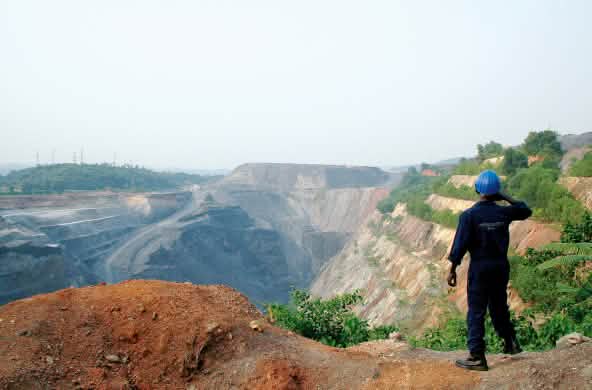
Gold
The romantic notion of gold prospecting has little in common with today’s mining operations. Find out about the environmental cost of our lust for gold – and what we can do to stop the insanity.