Forestry minister refuses to recognize Indigenous Papuans
Indonesia: Indonesia’s forestry minister has opened up half a million hectares of forest in Papua for the Merauke National Strategic Project. The ministry refuses to recognize Indigenous communities, treating their land and lives as it did under colonial rule. Five Indigenous Wambon Papuans are suing to protect their ancestral land.
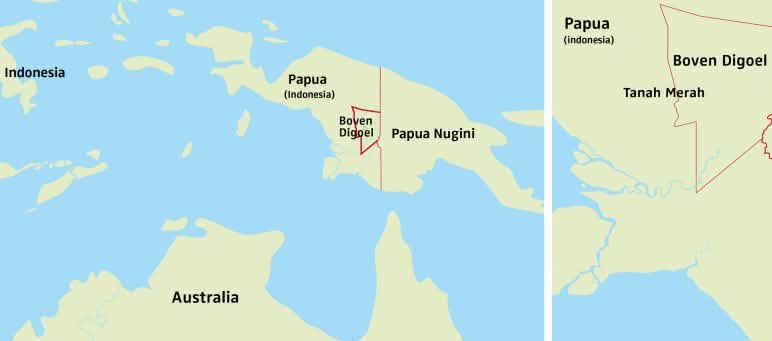
Under President Prabowo Subianto’s government, Boven Digoel regency is facing a new wave of deforestation. For the Merauke National Strategic Project (PSN Merauke), the Ministry of Forestry has reclassified 486,939 hectares of forest in Merauke, Mappi and Boven Digoel regencies as “non-forest land” by decree. This clears the way for oil palm and sugarcane plantations to produce biodiesel and ethanol. The plantations are set to cover a total of two and a half million hectares.
The entire plan calls for the destruction of more than two million hectares of Indigenous Papuan forest.
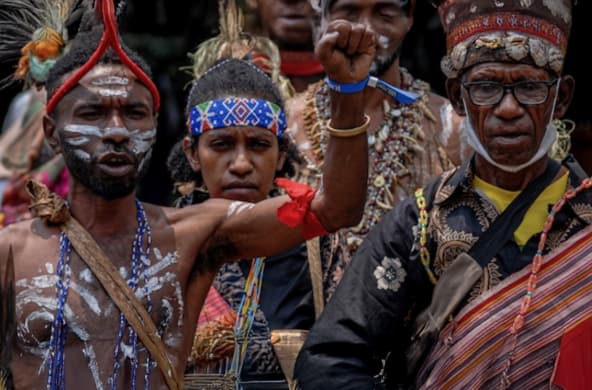
Papuans, including the Wambon people of Boven Digoel, are fiercely resisting this vast, state-planned destruction of forests.
After years of difficult work, the regency officially recognized the Wambon’s ancestral forest (Hutan Adat). The Ministry of Forestry in Jakarta, however, still has not. By reclassifying it as “non-forest land,” the government has stripped away its legal protection and opened the forest to clearing – disregarding the principle of Free, Prior and Informed Consent (FPIC), Indigenous rights and every climate agreement and forest protection pledge.
The Wambon case exemplifies the oligarchy’s ruthless actions against Indigenous people and nature, its tendency to violate laws and agreements and the glaring failure of the legal system.
The Wambon people’s legal case against the forestry minister
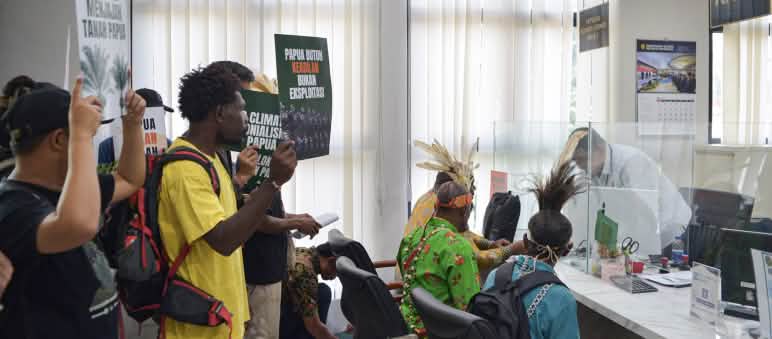
The Indigenous communities filed objections to the Ministry of Forestry’s decree. When the ministry ignored them, five Indigenous Wambon people filed a case with the Administrative Court in Jakarta.
The proceedings have now entered the evidentiary stage. The Indigenous people’s legal representatives have submitted evidence, and the forestry minister has filed his written response to the lawsuit.
Statement by attorney Tigor Hutapea, representing the Wambon
The Ministry of Forestry does not recognize Indigenous communities.
“The forestry minister’s response implies that he does not recognize the five plaintiffs as Indigenous people and owners of the customary territories where they have lived for generations. He is asking for the case to be dismissed. We, the lawyers, believe that the forestry minister follows a positivist line of thinking and adheres to the principle of ‘domein verklaring’ – a legacy of Dutch colonial rule – when he claims that customary territories are considered ownerless and therefore fall entirely under state control. This is the source of the many conflicts over land and natural resources.
The Ministry of Forestry claims that Indigenous territories are ownerless and subject to unrestricted state control.
We also question the delay in recognizing Indigenous forests. The five plaintiffs have already received recognition from the regency, but have been waiting since 2023 for the Ministry of Forestry’s decision. By contrast, the forestry minister changed the status of the forests quickly, without the consent of Indigenous communities and without an adequate assessment.
The forestry minister is violating Indigenous communities’ rights.
Deforestation has severe impacts on ecosystems. The area contains 166,325.314 hectares of High Conservation Value (HCV) forest. These forests are of major biological, ecological, social and cultural importance at local, regional and global levels.
There are also 51,333 hectares of peatlands – the largest areas are in Boven Digoel – as well as 61,370 hectares of primary forest. Under the law, they are protected, and no permits may be issued.
These forests store 27,079,656 tons of carbon, and clearing them would release 99,292,072 tons of carbon dioxide. Deforestation violates Indonesia’s climate protection commitments. We therefore call for the repeal of Forestry Ministerial Decree No. 591 of 2025.”
People and nature in Boven Digoel
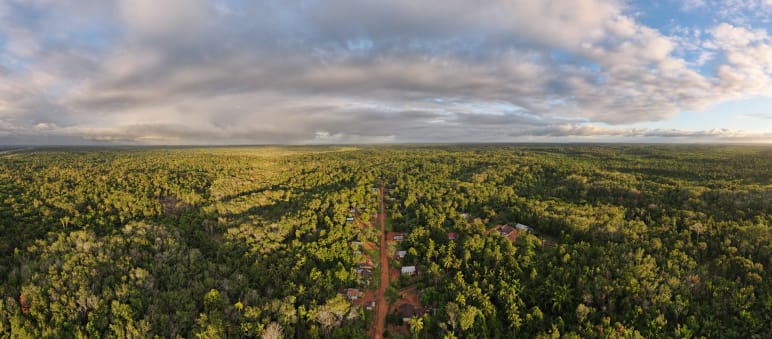
The regency in South Papua Province, north of Merauke, covers 2.71 million hectares – an area roughly the size of Massachusetts or more than twice the size of Northern Ireland. Two million hectares are forest.
Some 74,000 people live here: around 50,000 Indigenous people – the Wambon, Muyu, Awyu and Korowai – and more than 20,000 migrants from other Indonesian islands.
Its wildlife and plant life are among the most remarkable on Earth, yet also among the least scientifically studied. The primary forests, peatlands and waterways support rich biodiversity, with an exceptionally high proportion of endemic species.
The vegetation includes lowland rainforests and peat forests, with mangroves and savannas in the south. Giant tropical trees such as ironwood (Intsia, merbau) dominate, alongside an immeasurable variety of climbing plants, ferns and epiphytes.
Birds of paradise and cassowaries, tree kangaroos and cuscuses live here. The Digoel River, about 525 km long, is home to at least 30 known fish species as well as freshwater and saltwater crocodiles.
Timber, palm oil, poaching
Logging of valuable merbau trees, clearing for plantations and poaching are putting this natural haven at risk before it can even be fully documented.
More than 410,000 hectares have been granted to companies as concessions, and several tens of thousands of hectares have already been cleared. Most of the area is still forest and is fiercely defended by the Indigenous communities.
Several of Southeast Asia’s most influential corporations operate in Boven Digoel. The region is being exploited through the interplay of established multinational corporations, shadow companies and new state megaprojects.
The South Korean-Indonesian Korindo Group has been active in Boven Digoel for decades, first through logging and now through oil palm plantations extending as far as Merauke. Korindo has been accused of using fire to clear land and of land grabbing.
A few years ago, Malaysia’s Menara Group received approval for the world’s largest oil palm plantation, covering 280,000 hectares. It secured the concession by dividing it among seven companies and using opaque corporate structures.
The Awyu Papuans are fiercely resisting this, on the ground and through the courts. They succeeded in getting the then Ministry of Environment and Forestry to impose clearing bans on two of the companies, and the Supreme Court upheld the bans in landmark rulings. More than 65,000 hectares of primary forest were saved from the chainsaws.
Since 2024, the more than two-million-hectare Merauke National Strategic Project has been imposed through military force. Our website has numerous reports: search for “PSN Merauke”.
At least ten companies and holding company consortia are active in the context of PSN Merauke:
- PT Global Papua Abadi (GPA): sugarcane plantations, sugar and bioethanol factories
- PT Murni Nusantara Mandiri: sugarcane plantations
- Jhonlin Group and subsidiaries: land clearing and infrastructure projects
- PT Agrinas Pangan: state-owned; land clearing and 30,000 hectares of rice plantations (“Food Estate”)
- PT Andalan Manis Nusantara: 60,000 hectares of sugarcane plantations, sugar and bioethanol factory, biomass power plant
- PT Semesta Gula Nusantara: 66,000 hectares of sugarcane plantations and bioethanol
- PT Dutamas Resources International: 60,000 hectares of sugarcane plantations, sugar and bioethanol factory, biomass power plant
- PT Borneo Citra Persada: 50,000 hectares for sugarcane, rice and cattle farming
- Merauke Sugar Group (MSG): the Fangiono family’s holding company, coordinating the sugar and bioethanol industry
- PT Sucofindo: feasibility studies
- PLN: state electricity company
This page is available in the following languages:
Indonesia: Stop the destruction of Papua’s Marind forest!
Indonesia is implementing a sugar and ethanol program in southern Papua under military protection. Two million hectares of rainforest and Indigenous land are at risk.
Supporting rainforest defenders
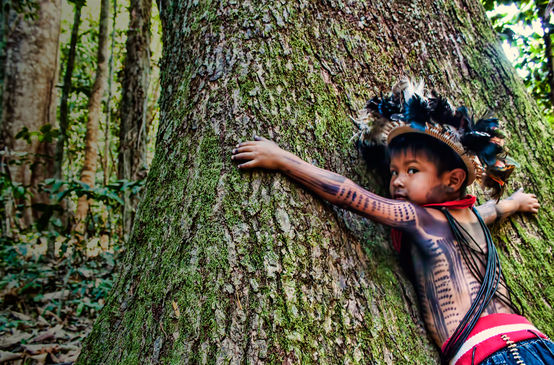
Rainforests are in particularly good shape wherever Indigenous people live and local communities are committed to conservation.
The rainforest
A green sea of ferns, mosses, vines and ancient trees. Iridescent butterflies and colorful birds. Flowers in every hue of the rainbow. The “green lung” is a natural wonder of the world. Find out more about the world’s most diverse, fascinating and threatened ecosystem.