How intimidation lawsuits backfire
The company Socfin is known for its plantations in Africa and Asia – and for its legal attacks on NGOs. In Belgium, three such organizations are now pushing back in an unusual way: They are suing the plaintiff.
When environmentalists, human rights advocates and journalists discuss the plantation company Socfin and its shareholder Vincent Bolloré, one question often hangs in the air: Are we risking being sued for what we say? Are we exposing ourselves to SLAPP lawsuits designed to silence us?
The company and the billionaire are notorious for taking critics to court, repeatedly suing journalists around the world. Now, however, the Belgian organizations FIAN, CNCD and Humundi / SOS Faim have sued Socfin for damages. Previously, the company had leveled unfounded accusations against the organizations and several of their staff. Mounting a successful defense cost them a great deal of money and time.
Socfin operates rubber and palm oil plantations in Africa and Asia. Bolloré and businessman Hubert Fabri are major shareholders. According to the newspaper Libération, however, Bolloré’s lawyer notes that his client is only a minority shareholder and that it is “completely wrong” to claim that he controls the plantations.
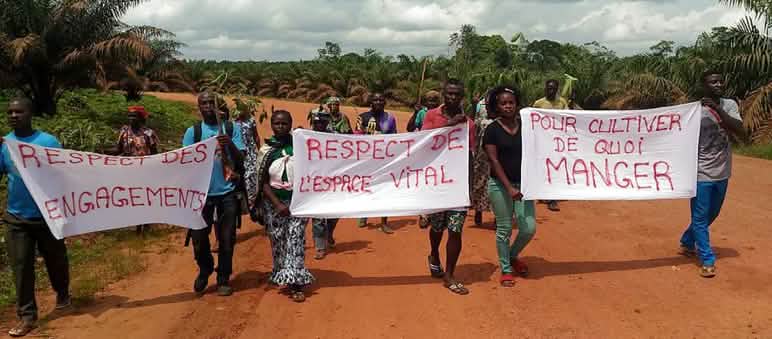
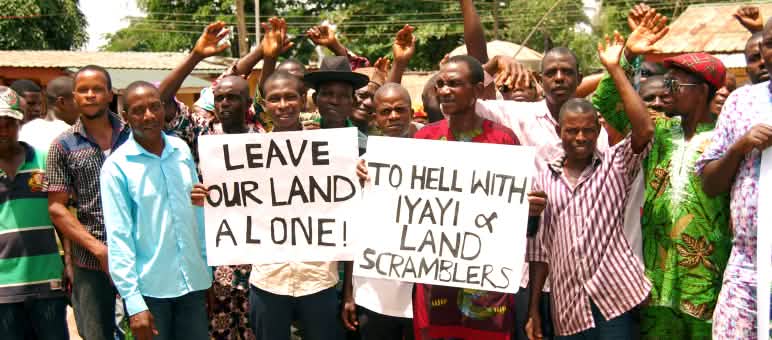
For many years, people living near the plantations have been raising allegations against Socfin and its subsidiaries – about pollution, land grabbing, the loss of livelihoods, poor working conditions and violence. An international coalition of human rights and environmental organizations is backing the affected communities. Rainforest Rescue has been particularly active around Okomu Oil Palm Plantation in Nigeria. We launched a petition that was signed by 126,777 people and supported human rights defender Ajele Sunday (We have since scaled back our involvement.).
2019: Socfin unleashes its lawyers
The NGOs’ current lawsuit has its roots in 2019. Back then, Socfin sued the three organizations FIAN, CNCD and SOS Faim in Luxembourg for defamation and slander, demanding 110,000 euros in damages. The trigger was a FIAN study on an oil palm plantation in Sierra Leone that documented land grabbing, water pollution and the loss of livelihoods. CNCD and SOS Faim distributed the report at the company’s annual general meeting and elsewhere.
While Socfin claimed that all accusations were false and completely unfounded, the district court ruled in October 2024 that the statements made “have an adequate factual basis”.
Was it an intimidation lawsuit?
A large corporation versus small organizations, high claims for damages, proceedings dragging on for six years – it is hard to escape the impression that Socfin’s lawsuit was meant to wear down its critics. In the eyes of the organizations, Socfin “systematically attacks NGOs or members of civil society who dare to denounce abuses and serious violations of the most fundamental human rights.”
This would make Socfin’s lawsuit a strategic lawsuit against public participation – a SLAPP – whose main purpose is to shut down public debate.
SLAPPs are a growing threat to democracy in Europe. In February 2024, the European Union therefore adopted a directive against such lawsuits – a move we strongly supported with a petition signed by 231,595 people. Unfortunately, the German anti‑SLAPP law, which implements the EU rules, is toothless and will hardly protect organizations like ours against plaintiffs such as Socfin or Bolloré.
The lawsuit brought by FIAN, CNCD and Humundi is a powerful way of pushing back against SLAPPs – and a landmark case.
According to the news agency Bloomberg, the company has filed fifty lawsuits against NGOs, activists or journalists worldwide. As early as 2018, the UN Human Rights Council pointed to “intimidation of NGOs that had reported allegations of human rights violations”.
In response to questions from “Libération”, Socfin “explicitly disputes” Bloomberg’s figure: “Our group fully respects freedom of expression and the role of civil society, but reserves the right to respond – including by taking the appropriate legal action.”
Socfin and its subsidiaries have sued journalists from Mediapart, L’Obs and Le Point, as well as the NGOs Sherpa and ReAct.
FIAN stands for Food Information and Action Network,
CNCD is short for Centre national de coopération au développement,
Humundi previously operated under the name SOS Faim, which stands for SOS Hunger.
Socfin had the allegations investigated by the organization Earthworm in a two‑year review, presented plans to address the grievances and recently published further Proforest reports on alleged progress.
This page is available in the following languages:
Liberia: Protect forest defenders, reject false climate solutions!
Liberia’s rainforests still stand because communities defended them. Now a proposed Carbon Market Policy threatens their rights.
Protecting Africa’s rich natural heritage
The Congo Basin is home to the second largest rainforest in the world, habitat of gorillas, chimpanzees and forest elephants. Our partners courageously defend these forests.

The rainforest
A green sea of ferns, mosses, vines and ancient trees. Iridescent butterflies and colorful birds. Flowers in every hue of the rainbow. The “green lung” is a natural wonder of the world. Find out more about the world’s most diverse, fascinating and threatened ecosystem.